by bungalow101 | Jan 3, 2023 | The History
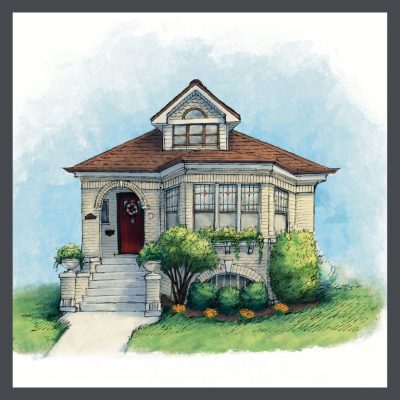 The story of the Chicago bungalow isn’t about the houses, it’s about the humanity. I call it, “Grits & girdles history.”
Because our houses tell the stories of the lives of the people who built them & how they lived, worked & formed their communities- the intimate details if you will. (In fact, I produced a historic documentary film about a bungalow neighborhood in Tampa that was full of the juicy goings- on of the time.)
The Chicago bungalow may be the most striking example of regional uniqueness to be found in the United States, in terms of single-family housing. There is no mistaking a Chicago bungalow which has many character defining features that are simply not seen in other areas of the country because they do not provide the same history or environment.
These features were developed out of the events that happened in the city, the natural resources & challenges, the man-made materials & technology that were available in the area during the period of their planning & construction.
THE STORY
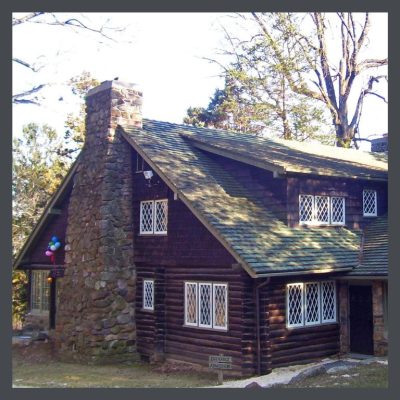 There were a great many influences that resulted in the Chicago bungalow, the first of course, being the Arts & Crafts Movement in England, a pushback against the overproduction of shoddy goods that characterized the Industrial Revolution.
The philosophy & design of the Movement were imported to the U.S. by Gustav Stickley, a furniture designer, writer & innovator. The Chicago bungalow veers wildly from Stickley’s ideal of a log cabin in the woods as they are built of brick & sit on a 125’-by-25’ lot in a city, which by 1910 was the home to over 2 million souls, the second largest in the United States, after New York. Not the low, wide structures of the American West on their expansive lawns, nor Stickley’s rock chimneyed log house in the woods, but bungalows they were-tidy compact brick muffins sitting prettily on the narrow city lots.
The Chicago bungalow provided exactly the modest refuge that was needed by the working class at the time, many of them immigrants, who had come to work in the factories & meat packing plants. Nearly 80,000 homes were built, each one with its own subtly distinctive charm & character.
 The next great influence was the Chicago Fire of 1871, which started in a barn & burned for over a day, killing 300 people. Because of the pressure to build houses to accommodate the growing population, buildings had been constructed using quickly assembled, cheaply constructed balloon-framing, with studs running from the foundation to the roof. Fire travels upward & there was nothing to stop it as it roared up the walls & turned the houses to ash, making a third of the city homeless. After this disaster, the city enacted new building codes & rapidly rebuilt the city according to those codes. With brick.
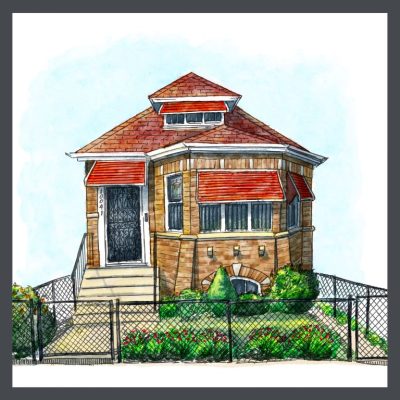
When you think of a Chicago bungalow, brick does come instantly to mind. The area was gifted with an abundance of clay by the glaciers that moved through the area over 10,000 years ago leaving their assorted debris so the resultant, fired bricks are speckled in a variety of colors. To satisfy the demands of the building boom in 1910, nearly a billion of these cheap bricks were produced. When I say cheap I mean cheap, averaging $7 per thousand while the better, more homogenous brick sold for as high as $35 per thousand.
So, builders took advantage of this cheap brick & used it to build areas that were not so visible, like foundations, structural walls, chimney flues & the back & sides of the house. Because Chicago is centrally located & a railroad hub, it was easy to bring all types of brick from all over the country so the front facades of bungalows show a charming diversity of brick types.
THE CHICAGO BUNGALOW STORY-ILLUSTRATED
 The images that you see here are created by Wonder City Studio by Phil Thompson & his wife Katie who are obviously in love with their town. He has created many drawings of Chicago buildings of all types, including capturing the sweet, sturdy hominess of the bungalow.
He features prints of his representations of the city, but, he also does commissioned portraits of homes anywhere. When I lived in Eagle Rock we had plein air painters (an Eagle rock tradition, historically) lining the walking tour route, many painting the homes of the tour hosts. The paintings were then auctioned for charity at an exhibit later & the homeowners were always the highest bidders for the paintings of their own homes. A portrait captures the soul of a house much more eloquently than a photograph (well, than a photograph of a mere mortal. You have to allow for the work of Alex Vertikoff.)
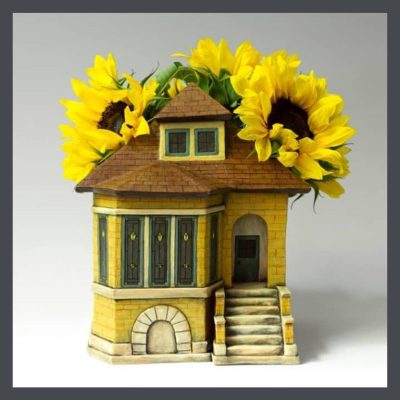
But, wait, there’s more! Katie Lauffenburger, wife, mom & founding partner of Wonder City Studio, will sculpt a custom planter Mini-Me of your home. And you can put flowers in it!
Although we may dream of living in our homes forever, sometimes life necessitates change & having either a beautiful drawing or a tiny 3-D model of it could mend a broken heart.
THE CHICAGO BUNGALOW ASSOCIATION HAS THE FULL STORY
What I can tell you about Chicago bungalows is a tiny fraction of the knowledge that the Chicago Bungalow Association posses & teaches. I just wanted to whet your appetite for this architectural form, unique in all the world to the Windy City.
 STAY IN THE BUNGALOW KNOW!!!
Sign up for our newsletter & receive our FREE E-book, 7 VITAL Things to Do Before You Hire a Contractor.
by bungalow101 | Dec 31, 2022 | Doing it the right way
 By attending old house classes, a conscientious steward can learn the basics of old house repair & maintenance. Owning an old house is not for sissies, nor for the uninformed. When I owned The Hare House, my 1910 Craftsman in Eagle Rock, I made some mistakes that I would have not made, & tossed away money that I would still have in my pocket, had I access to any of the education offered below.
Even if you are not a hands-on restorer, by inclination, aptitude (or the lack of) or physical condition, you need to have some knowledge of these skills.You can also use them to educate any trusted tradesman that you have working at your home to expand their skills. This can save you money & provide you with services to which you might not have access in your area.
I suggest contacting the event producer about any classes that appeals to you that might require physicality beyond your own capabilities, to see if they can accommodate you. They want you to learn so they will make it as easy as they can for you.
The best thing about attending is that it gives you the opportunity to meet like-minded folks. I have met wonderful people in my preservation activities & formed many strong friendships. I urge you to participate. It will enrich your life!
I AM FULLY AWARE THAT MY LIST IS WOEFULLY INCOMPLETE! Please let me know what I have missed so that I can add them.
OLD HOUSE CLASSES IN THE NORTHEAST
 Craftwork Training Center
Telford, PA
Hands-on workshops are taught by professionals who are looking toward building the resources necessary preserving the future of the trades.
Participants learn a variety of crafts in order to pursue & succeed in vocations in the preservation trades. The Center’s goal is to build the next generation of highly trained artisans.
They offer classes in:
- Historic Preservation Boot Camp is a 3-day workshop covering repointing, plastering, & brick/stone repairs
- Repointing Brick & Stone Using Lime Mortar
- Repointing Special Joint Profiles Using Lime Mortar
- Basic Plaster Wall Repair
- Brick & Stone Surface Repair
- Sash Mechanics of Historic Windows
- Restoring Historic Wood Windows & Doors
- Basics of Building with Hempcrete
OLD HOUSE CLASSES IN THE MIDWEST
 Chicago Bungalow Association
“Now serving all old homes.”
The Association offers an extensive menu of seminars, webinars & hands-on workshops, designed to help you preserve & improve the appearance, usability & value of your home.
Though they focus on bungalow, they offer help to anyone who owns an old house of any style or age. They are some of the friendliest people in preservation that I have ever met. I have called them several times with questions regarding bungalow characteristics in the Midwest & they have always gone out of their way to obtain the information requested & relay it to me.
Take advantage of their many educational videos on many subjects, all beautifully & clearly presented.
Sign up for their email list so you can stay informed whether or not you live in Chicago! If you do live there, you’re welcome.
 Belvedere School for Hands-On Preservation
Hannibal, Missouri
Bob Yapp, after traveling the country, teaching preservation skills, had the dream of establishing a hands-on trade school, delivering workshops to students of all ages, lasting from 2 day to 8 days. His students come from all parts of the world to learn from this master.
The Beleveder School is lodged in the historic brick, antebellum, 1859 Italianate, Alfred Lamb Mansion which also holds his wife’s bed & breakfast. Known for its delicious breakfasts, the B&B provides a wonderful setting for making lifelong friends.
He also delivers seminars & workshops on many different topics to communities all over the U.S.
 Preservation Corps United
Des Moines, Iowa
Founded in 2022, Preservation Corps United offers expert education in historic preservation & restoration to homeowners & construction professionals.
The founder, Tanya Keith, offers some impressive credential& & imparts this knowledge to those who attend her school.
Education:
2.5 years of Industrial Design program at Carnegie Mellon University, BFA Interior Design from Iowa State University with minors in Craft Design: Woodworking and Sociology
NCIDQ Certified Interior Designer since 2001
Belvedere School for Hands on Preservation Certificates:
Passive Wood Floor Restoration, Building Wooden Storm Windows, Restoration of Historic Stained Glass, Historic Plaster Repair, Historic Masonry Repair
Certified in Window Restoration by David Wadsworth.
Rethos
Saint Paul & Winona, Minnesota
“Whether you’re an individual or part of a group or business, if you believe in a future that honors our old buildings, beautiful towns, and our culture, you are a part of Rethos.”
Rethos is a non-profit organization offering hands-on & Zoom classes as well as informative videos to homeowners in all aspects of preservation. They are perfectly amenable to your attending a workshop without physically participating. You can learn a great deal by just watching! They offer classes such as:
Lead, Asbestos & Radon
Old Home Certified for Realtors®, a regional designation
Window Restoration
Drafting a Maintenance Plan
Wallpaper Installation
DIY Plumbing
PROFESSIONAL (OR WANNA-BE PRO) WOOD WINDOW RESTORATION EDUCATION
Wood Preservation Alliance
This group, composed of the most knowledgeable people in the field from all over the country, is a trade organization dedicated to saving old wood windows. In addition to connecting pro’s with homeowners, they assist everyone from those who want to have careers in wood window restoration, to established pro’s.
The WPA provide resources & information on products & materials as well as general information on running a successful business. They also “help preservationists find the tools they need to educate building owners, architects, and other decision makers about the value of original windows.”
If you wish to host a old house classes, contact them to see if they could provide you with a speaker/demonstrator. If you, or someone you know would like to spend your life returning old houses to their former glory, they are standing by to give you the education & assistance you need to be a successful professional.
PRODUCE OLD HOUSE CLASSES IN YOUR AREA
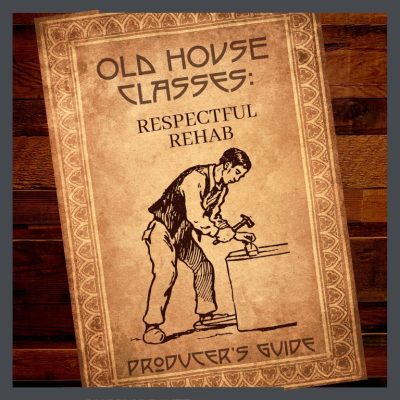 I am working on a manual (It’s pretty close to being done.) for hosting such an event, laying out step-by-step what to do to choose topics, attract craftsmen & volunteers, promote it & make some $$$ for your organization, & run a smooth-running day of hands-on, old house learning.
The manual is divided into sections, & I have included a timeline that cross references the sections so that you can go step-by-step through locating a venue, attracting speakers & demonstrators, recruiting enthusiastic volunteers & promoting the event to the public.
Let me know if you or your organization is interested in learning how to host classes & I’ll get working on this thing a bit faster! I’m going to sell it for a whole $25.00 because if you pay for it, you’re more likely to use it.
LOCAL HISTORIC PRESERVATION ADVOCACY GROUPS’ CLASSES
Many preservation groups host classes so if you are interested in attending, contact your local group. I am building lists of such groups, but it’s taking a ridiculously long time to create such a list for all 50 states so if you don’t see it here, Google “historic preservation your city.”
If you are involved in a preservation group, please encourage them to host old house classes. It’s a good P.R. activity, will encourage membership & it also can raise some serious funds.
THE BENEFITS OF OLD HOUSE CLASSES
Even if you have no plans to live the DIY life, it is important to understand how your house works. If any of these topics interest you, but you don’t have the physical capabilities perform the work, most of them will allow you to participate as an observer.
These are also great learning sources for the tradespeople who work for you. You need to have someone you can count on who has these skills & it may be up to you to ensure that they get them.
 There are young people all over the United States who would love to be trained in these trades & make this work their vocation. You can do your bit for preservation by letting them know about these opportunities. I have a book in my hip pocket that is about 50% complete, about how to run a successful specialty contracting business. My plan is to complete the dang thing & somehow raise the money needed to have it printed & then donate the books to high schools. So, someday I may be coming to you, asking for a hand-out & for your assistance in placing them!
STAY IN THE BUNGALOW KNOW!!!
Sign up for our newsletter & receive our FREE E-book, 7 VITAL Things to Do Before You Hire a Contractor.
by bungalow101 | Dec 29, 2022 | Features
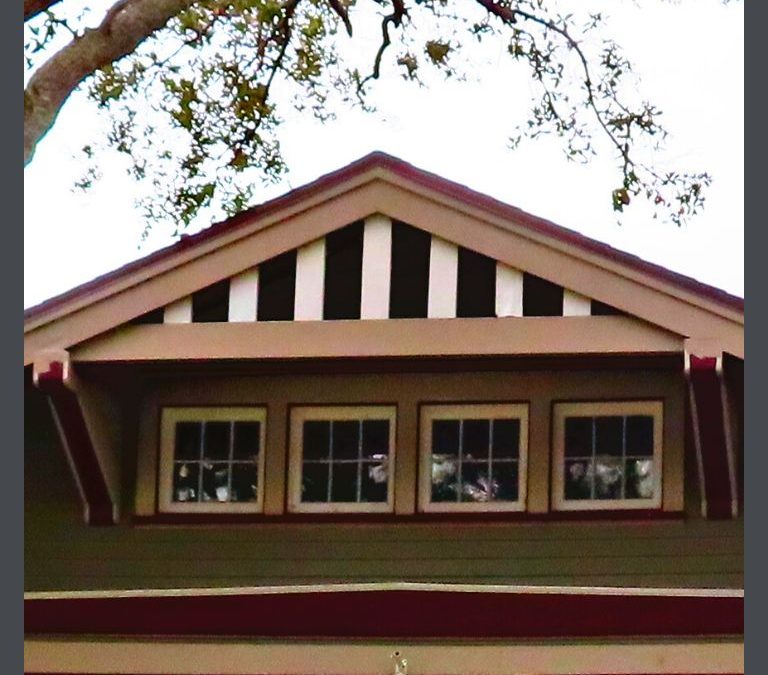
 Let’s break down some bungalow characteristics to better understand what makes a bungalow, a bungalow. Character defining features, as further explained in the Secretary of the Interior’s Standards for Historic Preservation Projects is a term that means the way the visual & material aspects of a particular house style that set it apart from other styles.
My friend Jo-Anne Peck, of Preservation Resource, Inc., & Historic Shed, is a historic preservation professional with a degree in Building Science, a Master’s of Fine Arts in Historic Preservation & licensed Florida Building Contractor with over 25 years experience in preservation. She has kindly provided these photos & this information based her her vast knowledge of bungalow preservation. They are grouped according to how they appeared on Facebook & I will add more from her every month, in a new part.
I am creating this page so that when I am asked, “What is a bungalow?” I’ll be able to point to these pages & after a bit, you’ll just know.
The links are to our glossary of exterior bungalow terms. Please follow it if you see a term that might be unfamiliar to you.
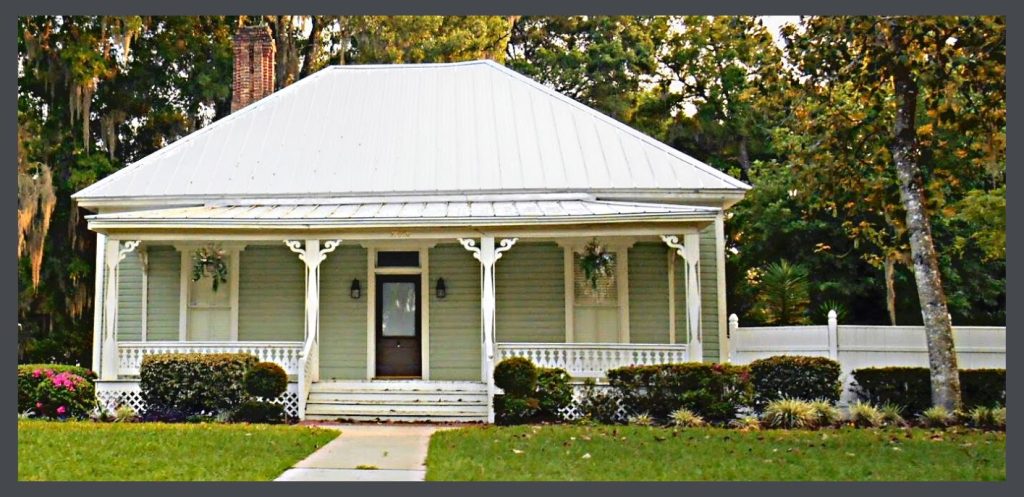
DESCRIPTION OF CHARACTERISTICS:
When someone says bungalow, we often first think of Craftsman style bungalows, but in reality, the term bungalow refers to the form of a house, not the style. Here is a Folk Victorian style bungalow with a hipped roof. I have to admit that I am partial to designs with a simple symmetry.
Here you can see some images of a more typical Folk Victorian.
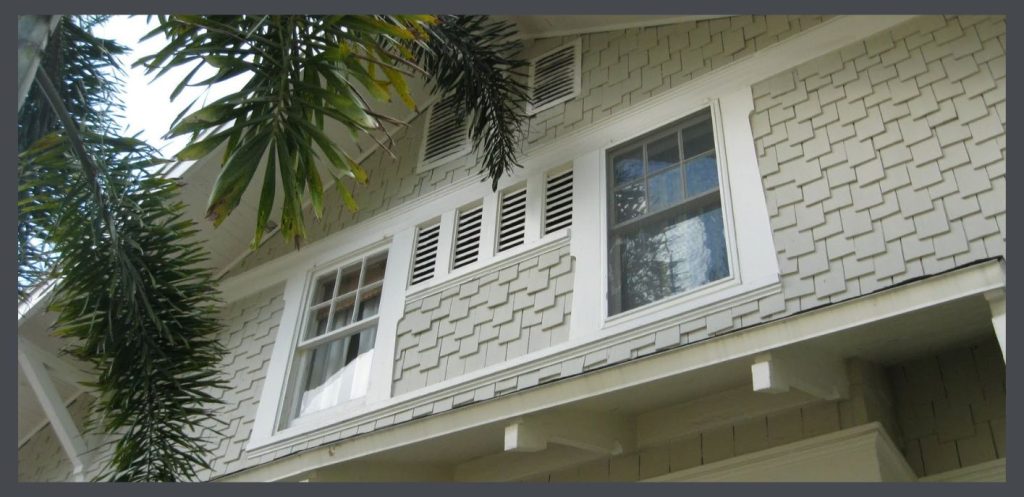
DESCRIPTION OF CHARACTERISTICS:
Texture, rhythm, and details. I love how the trim surrounding the windows flares differently on each side of the casing to accommodate the 4 vents. And look at the great cut rafter tails! This house was built by a craftsman skilled at their trade.
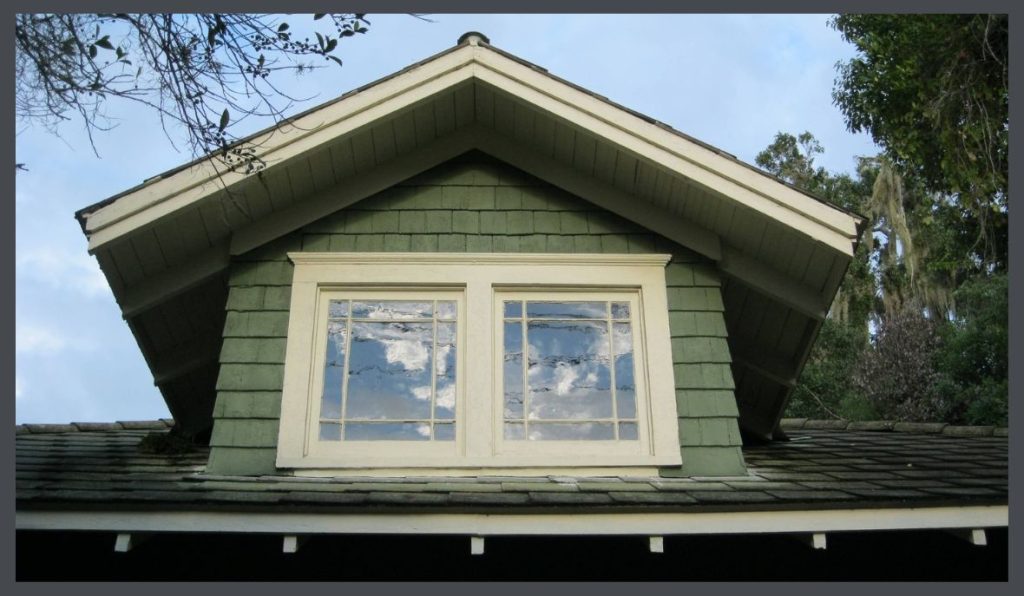
DESCRIPTION OF CHARACTERISTICS:
A gable dormer with shingle siding and divided lites with wavy glass. What more needs to be said?
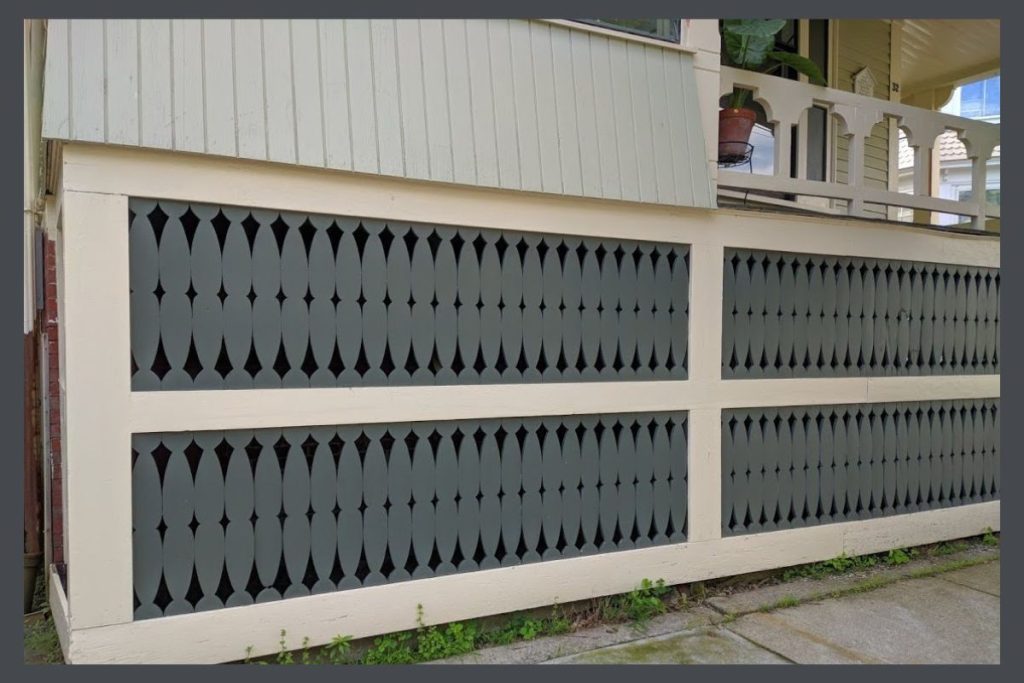
DESCRIPTION OF CHARACTERISTICS:
I know it’s a bit abnormal to get excited over foundation lattice, but I love when something so utilitarian and mundane is a design feature worthy of attention on its own. It’s a far cry from bright white plastic lattice, isn’t it?
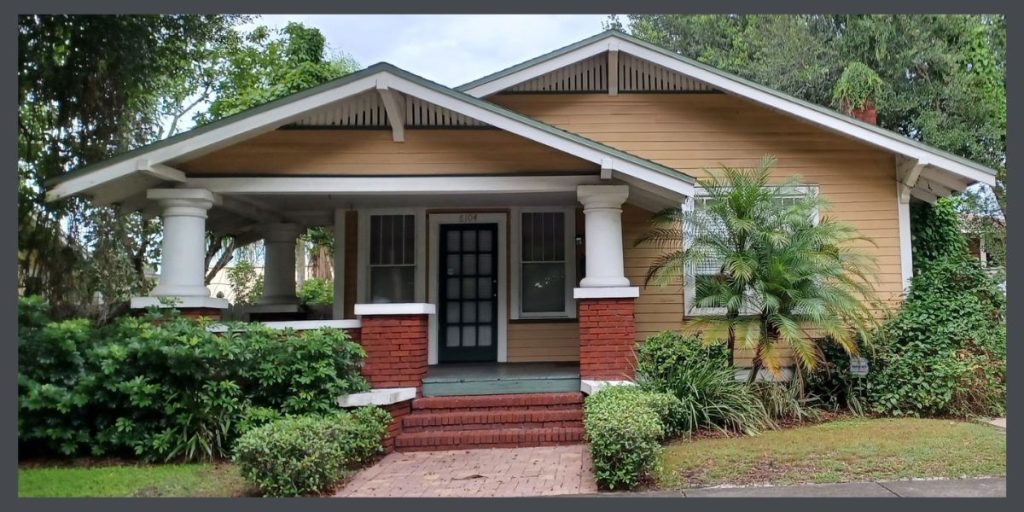
DESCRIPTION OF CHARACTERISTICS:
One of the most common Craftsman bungalow forms is the front facing gable house with a separate, front facing gable porch. The porch is often 1/3, 1/2, or 2/3 the width of the house. Or, as in the case of this structure, the porch wraps around the side of the house, making the porch roof nearly the same width of the house front gable, but still providing a separate roofline.
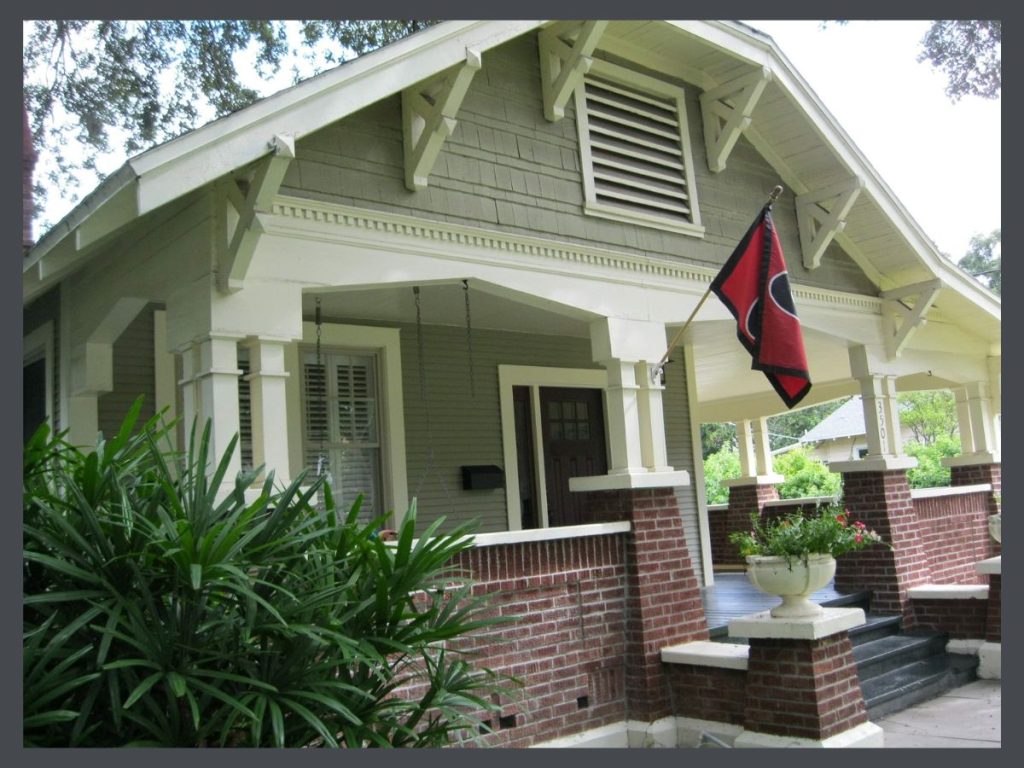
DESCRIPTION OF CHARACTERISTICS:
Some homes are so rich in detail that you just have to stop and take a photo!
This house in Tampa, FL has a lot going on from the jerkinhead roofline, to the surplus of eave brackets, porch dentil trim, paired and triple columns on sturdy tapered brick piers, shingled gable, and so much more …
DESCRIPTION OF CHARACTERISTICS:
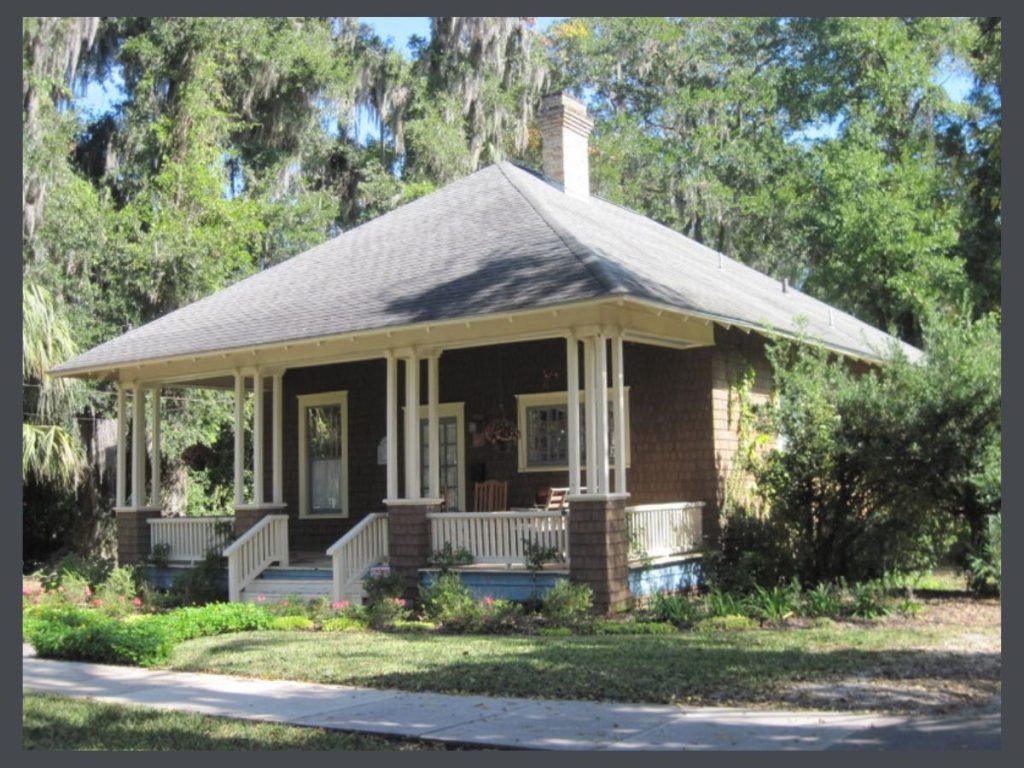
This bungalow has what is referred to as an integral porch, which means the roof is continuous over both the house and porch. It creates a clean, unfussy look and has no pesky transitions that can often be sources of potential leaks down the road. Shingle siding, exposed rafter tails and groups of 4 slender posts supporting the porch make for a lovely home.
STAY IN THE BUNGALOW KNOW!!!
Sign up for our newsletter & receive our FREE E-book, 7 VITAL Things to Do Before You Hire a Contractor.
by bungalow101 | Dec 27, 2022 | Doors & windows, The History
 From their framing to their siding to their doors & windows to their built-ins & their flooring, our old houses, are built of old growth wood. Thousands of board feet of it.
“Old growth.” What does that mean?
Let’s have a tree history lesson. Fossils show that the first tree-like plants, with vascular systems that transported water & nutrients, allowing the plants for the first time to rise up off the ground (Think moss.) & to form trunks & branches, developed 400 million years ago. Their evolution since then included the development of seeds & true woody stems.
Then,
Over 300 million years ago: The earliest conifers (i.e., cedar, fir, pine, redwoods & others) appear.
67 million years ago: Evidence of the first maple trees.
56 million years ago: Evidence of the first oak trees.
They continued to evolve & to create the great forests that covered most of America, generation after generation contributing to the next as they produced seeds, died & decayed, becoming part of the rich soil of the virgin woodland.
REDWOODS- THE LONGEST LIVING OF OLD GROWTH WOOD
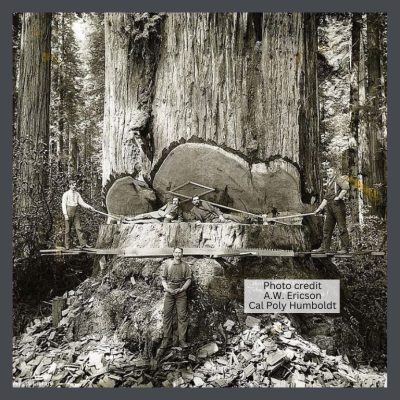 Let’s start with the Redwood, one class being the oldest plants on earth, living from about 800 to 3,200 years. On the west coast, before they were chopped to build our houses, they played an important part in the lives of early indigenous peoples who revered them, building structures from fallen trees. Native elder Minnie Reeves called them “a special gift from the Great Creator. Destroy these trees and you destroy the Creator’s love . . . and you will eventually destroy mankind.”
When California became a state in 1850, there were nearly 2 million acres of redwood forest. San Francisco was built twice with redwood, before & after the quake & fire of 1906. But the worst was yet to come. During the first half of the 20th Century when California experienced a major building boom, the redwood forest suffered its greatest losses, with trains of lumber heading south as trains of oranges headed north.
Going into the 21st Century, only 5 percent of the old growth forest still stood, thankfully protected on public lands.
In modern times, redwood farms produce wood for lumber, however, this new wood does not have the same high levels of toxic tannins, a type of bitter, astringent chemical compounds which protect the trees from fungus & insects & decrease its susceptibility to rot.
Selective cutting of young trees is permitted on redwood farms but these trees do not have enough age on them to acquire the decay & insect resistant properties of the old growth. If you want the original, old growth wood, you must buy it second-hand, salvaged from old buildings that some uninformed person has chosen to demolish.
OTHER OLD GROWTH CONIFERS IN OLD HOUSES
The Douglas fir forests of the Northwest were treated just as casually. The timber industry, both logging & milling’ developed into a huge industry. The quantities were regarded as unlimited, if they were regarded at all in the push to maximize profit. As harvesting & transportation technologies developed, so did the quantity of forest land destruction increase.
It wasn’t until the 1880’s that conservation of timber supplies was considered. National forests were established & research into good forest practices began.
OAK
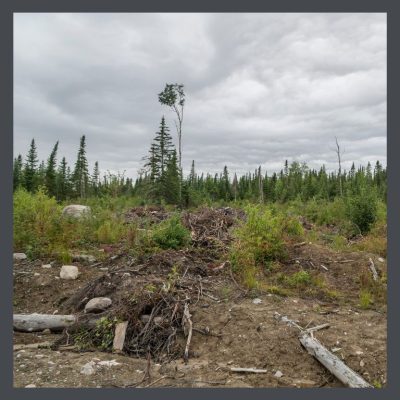 The Domesday Book of 1086, a survey ordered by William the Conqueror to record his holdings, indicated a forest cover of 15%, By the start of the next millennium, this coverage had dropped to 5%.
In the 17th Century, as thousands of colonists arrived in the United States from England, they placed heavy demands on the forests taking huge trees, some hundreds of years old, of many species for lumber not only for building but also for fuel. Additionally, they cleared lands for agriculture & livestock.
Additionally, after the Industrial Revolution, potash, potassium carbonate derived from burned wood was in high demand in the colonies & in England where they had already decimated their forests. By the early 1800’s, the pre-revolutionary American colonies were providing England with more than 60% of its potash.
The construction boom after WW I, especially during the mid-1920’s, furthered reduced our forest resources. You can read about pine’s story, in the forests of the Eastern U.S., here.
FARMED WOOD VS OLD-GROWTH WOOD
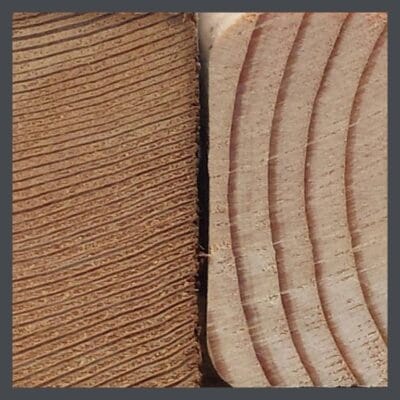 Trees are planted in man-made forests with the purpose of generating a large amount of product, fast. These farms do not replicate the ecology of the natural forest. Generally they are one species only, & all the trees are planted at the same time. The trees are planted in rows spaced to allow maximum sunlight & water exposure so they grow very fast. The old forests allowed trees to grow slowly, putting on more tightly-packed growth rings
Because of this, new growth wood does not have the strength, stability nor the decay & insect repelling properties of old growth wood- not to mention the beauty. But. stick with me here. I have a theory about additional environmental factors that made the virgin forests a much better place for trees.
The conditions in the old forests had evolved over millions of years. Co-evolution is the evolving of all the parts of an ecosystem to assist each of its parts survive better. i.e., evolutionary change over time, benefiting each interacting member, usually involving different species. Tree farms lack this dynamic. They are the new kids in school without a support system, not oriented to their environment, & growing in unnatural conditions.
The virgin forest is home to many tree species as well as hundreds of different insects, animals & microbes. All of these organisms have made reciprocal adaptive changes in cooperation with one or more other species, over the millennia, helping one another to survive with greater & greater efficiency.
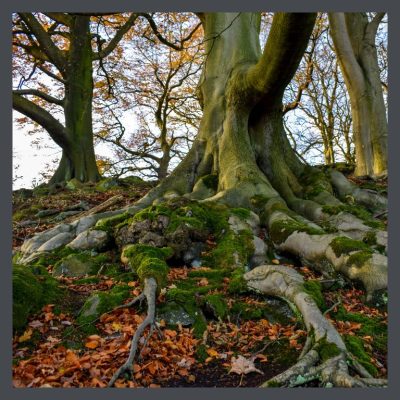 Much of this mutual adaptation involves microorganisms, the fungi that break down the fiber of the dead trees & turn them into nutritious soil, but also form a communication network for the trees. Watch this short video by National Geographic that explains how trees connect & share with one another.
Trees do not stand alone, competing with one another for sunlight, water & nutrients. Rather, the forest is almost like a single organism, the different trees interacting with one another, both within & outside their own species, through their roots & the fungal networks that connect these roots. They exchange communication & nutrients through this network, with the larger, old Mother trees forming the hubs. As an example, Douglas firs share excess sugars with the leafless birches in the spring & fall, & in return, the birches send sugars to the Douglas-firs in the summer, via the fungi underground.
Here’s my crazy theory. The health of the human body depends on the quantity & diversity of the microbes that live in the gut. To build a strong, healthy body, one needs a strong healthy microbiome- the colony of microorganisms within the body. This is a lovely short video of 2 Stanford researchers who have discovered much of what is known in this science. They have a big picture of bacteria over the fireplace in their home.
My hypothesis is that lumber from a tree grown in the virgin forest is better, stronger, more stable, more decay & insect resistant not just because it is old & bigger, but because it has grown up with a Mother, a family, neighbors & friends in the form of an active ecosystem that has had millions of years to get it right. “It’s not better because it’s old, it’s old because it’s better.”
What do you think?
FOR MORE INFORMATION ON OLD GROWTH WOOD, VISIT OUR OLD HOUSE RESTORATION VIDEOS- OLD GROWTH WOOD here.
STAY IN THE BUNGALOW KNOW!!!
Sign up for our newsletter & receive our FREE E-book, 7 VITAL Things to Do Before You Hire a Contractor.
by bungalow101 | Dec 26, 2022 | Doing it the right way, Features
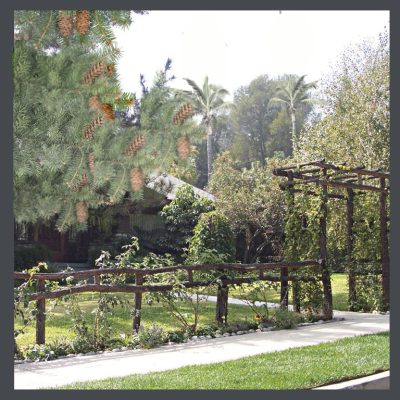 The story begins with my love affair with the Alfred W. & Grace D. Hare House, a beautiful Craftsman, in Eagle Rock, a bungalow neighborhood in N.E. Los Angeles. Once an incorporated town in its own right, Eagle Rock is just west of Pasadena & was clearly influenced by the architecture being built there.
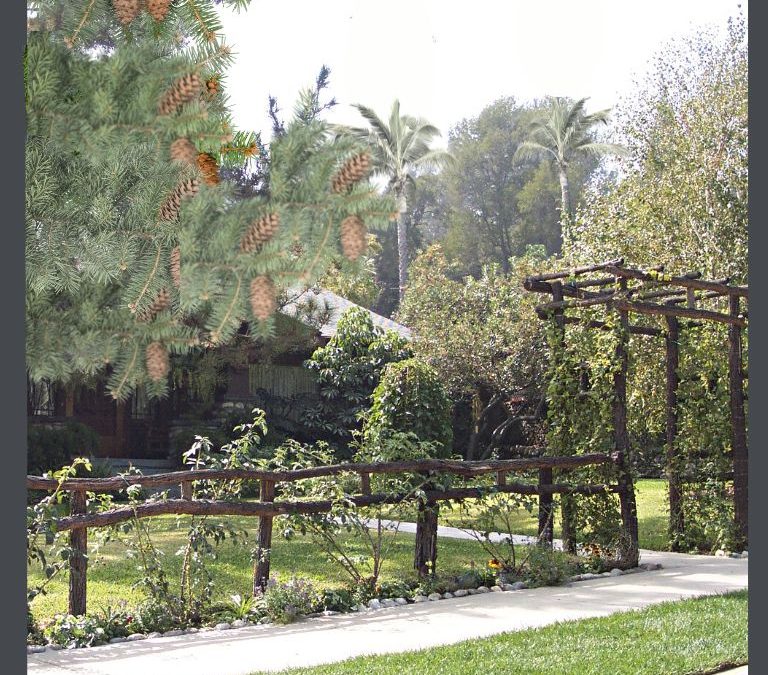
The entrance to the property is through an arbor that I had built with saplings that were so green that leaves kept growing long after the fence was constructed. An arroyo rock border lined the sidewalk & roses grew intertwined through the sapling fence. There’s a great, full page image of the arbor in BUNGALOW DETAILS: Exterior, on page 190
The rocks came from the nearby Arroyo Seco (which in Spanish means “dry gulch”) a canyon between Eagle Rock & Pasadena. This rock is a common material seen in houses in this area & clearly shows their place in the world.
My next-door-neighbor retired & got herself a chainsaw, Every time I heard the buzzing start-up, I’d grab my keys & head for the nursery to buy another tree. I ended up with a small grove of birches in the front & a shaggy, grafted tree that looked like a parasol under which fairies could dance, when it was first installed but turned into Cousin Itt as it grew. The house is on 1 1/2 lots & is set well back from the street, so the Addams family representative, the huge, aged pine & the new birches made a nice little forest.
MY ARTS & CRAFTS GARDEN
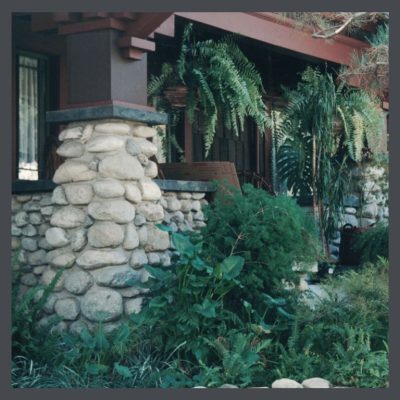 I also used the same rocks to form a path from the driveway to the front walk. I installed baby’s tears (Soleirolia soleirolii) a mossy appearing tropical perennial with tiny, tiny leaves between the path & the border. They were very soft & sweet & I coaxed them to grow so that they would provide a natural woodland look. A week before my mother was supposed to arrive to see the house for the first time, my gardener edged them so they were level on top & flat against the border. I am a plant whisperer but I admit that during that week I was more of a plant cheerleader & probably even a plant sergeant, alternating cheering & commanding them to grow back into gentle, fluffy mounds before my mom’s arrival.
Inspired by the origins of the Arts & Crafts Movement, I planted an English garden. Arroyo rock bordered the garden beds which I enlarged & planted with shade loving plants on the shady side & plants that looked like shade loving plants on the other side. It was very difficult! Los Angeles is not England. Los Angeles is a desert & plants easily fry in the sun, so I had to stretch my wits to fill a bed that got nuked every day with plants that could have maybe been in an English cottage garden.
A great deal of my planning was centered on choosing what I would want to cut, to bring in the house. I love old flowers, so I chose calla lilies & several different types of ferns so that I would have greens. I grew roses in honor of my mother & my grandmother. My grandmother was an accomplished rosarian, & in 1930, was certified as a rose judge.
THE HOUSE
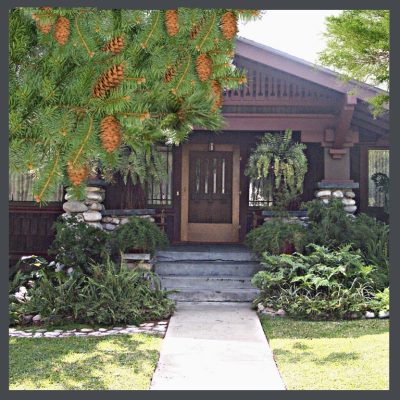 The centered, front-gabled porch is supported by massive timber framing & arroyo stone piers. A free-form arroyo stone chimney is on the east side. Sadly, I have no pictures of my chimney, but you can see it in Jane Powell’s book BUNGALOW DETAILS: Exterior, on page 57. It’s chunky!
Typical of Southern California Craftsman style, as one of the earlier houses built, the Hare House helped set the style for later homes in Eagle Rock. Its solid massing & low horizontal profile, is boldly embellished with honest decorative elements, employing simple & natural building materials. As celebrated by the Arts & Crafts Movement, there are many connections from the outside to the inside, with the inviting porch & the sunroom & the many large windows, both casement & doublehung in every room of the house.
The entry features a centered Douglas fir door with 4 beveled lites. We added a screen door (not original) of quartersawn oak with brass screen. You can read about the door & the tiny faces who loved to look out of it here.
The shingle siding was stained when i purchased the house. I hire an inexperienced painter who had slapped a coat of paint on it by the time I arrived home from the office. We had chosen colors together & I thought that he noticed that I was showing him stain samples, but he did not. There is a good chance that he had never stained a house & didn’t know that you could. It broke my heart. I felt like I had betrayed the house.
THE BUILDER OF MY CRAFTSMAN IN EAGLE ROCK
The original owner (through 1923) Rev. Alfred W. Hare & his wife Grace D. Hare made significant contributions to the community of Eagle Rock & the City of Los Angeles.They were both active in the cultural, social & religious life of the town. Local papers of the time feature many stories of their travels, their house guests & their participation in events on behalf of the town’s various social organizations, such as the Women’s Club, the Elks, the Red Cross & the Near East Relief work after the war.
Ordained as a clergyman of the Congregational Church in 1896, Hare moved to Eagle Rock in 1909 as pastor of the shuttered Eagle Rock Congregational Church. Soon after, due to his inspired success of the church, Hare oversaw the construction of a new church building.
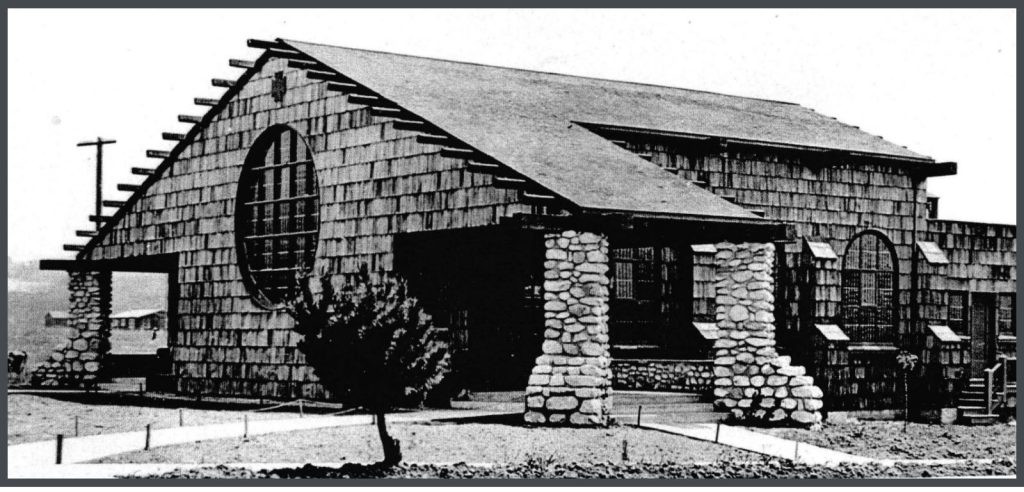
Sadly, this church, an extraordinary example of Arts & Crafts design, is no longer standing. I have been unable to track down both the architect of the house & of the church. To my eye, the house & the church were not drawn by the same hand. I would love to know your opinion of this.
After 1912, he was the pastor at other churches in Los Angeles, notably 27 total years at Park Congregational Church in Angeleno Heights.
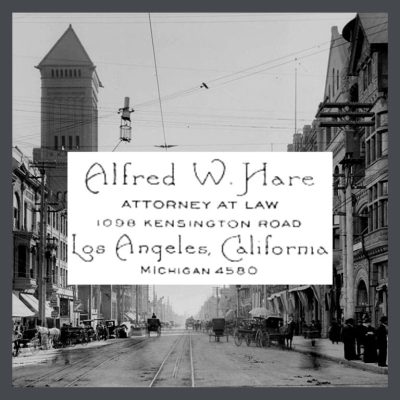 Admitted to the Los Angeles County Bar Association in 1912, Hare founded the large & successful law firm of Hare & Walden situated in downtown Los Angeles, which was connected by trolley to Eagle Rock. The little home office, with its built-in desk & fireplace was probably well-used by Hare, writing sermons, counseling parishioners & then, after he began practicing law, working on cases that he brought home from the office so that he could be with his wife, Grace.
Mrs. Grace Dunsmoor Hare had been a “successful & popular” teacher & was the daughter of Charles Dunsmoor, who was County Clerk of Los Angeles County & California State Bank Commissioner. Both Mr. & Mrs. Hare were revered leaders in the realms of social activism & philanthropy in their community of Eagle Rock.
Learning these things about them helped to explain the house. Though one of the finest homes in the neighborhood, it was situated well away from the grah-ah-ahnd street of the town, Hill Drive. Learning of Reverend Hare’s astute ability to handle money -he helped several churches whose congregations he led to tear up their mortgages- my surmise is that he thriftily chose a less pricey, but large & beautiful lot on which to build.
The house, at 1950 square feet had only 2 bedrooms. In none of my research on him have I seen any evidence of children. In later years Grace was sickly & I wonder if her maladies could have affected her fertility. By the time the house was built, they had been married for 7 years & had probably stopped hoping to grow their family.
 The public areas were clearly designed for entertaining with a large living room & dining room, as well as a sunroom. I can easily imagine gay fundraisers for the Women’s Twentieth Century Club building fund to have taken place there, with Alfred playing the guitar & the 2 of them singing, perhaps accompanied by his sisters who wrote songs & skits to contribute to the effort.
Almost 100 years later, I was a member of Club & participated in fundraising events to restore & preserve the beautiful building. Again, I wonder at the architect because all the members of the Hare family, Alfred, Grace & his 3 sisters were instrumental in the fundraising that enabled it to be built & they possibly would have had some influence in its design.
It was an honor & a privilege to hold the stewardship of this beautiful home. When I restored it, I kept the Hares in mind & strove to create make choices that would please them & create a space in which they would feel comfortable. The woman to whom I sold the house held them in the same regard & the remaining restoration that she performed, was done with the same reverence, for the family, the neighborhood & the period.
TIP: TO READ MORE ABOUT MY LOVE AFFAIR WITH THE HARE HOUSE, CLICK HERE.
STAY IN THE BUNGALOW KNOW!!!
Sign up for our newsletter & receive our FREE E-book, 7 VITAL Things to Do Before You Hire a Contractor.