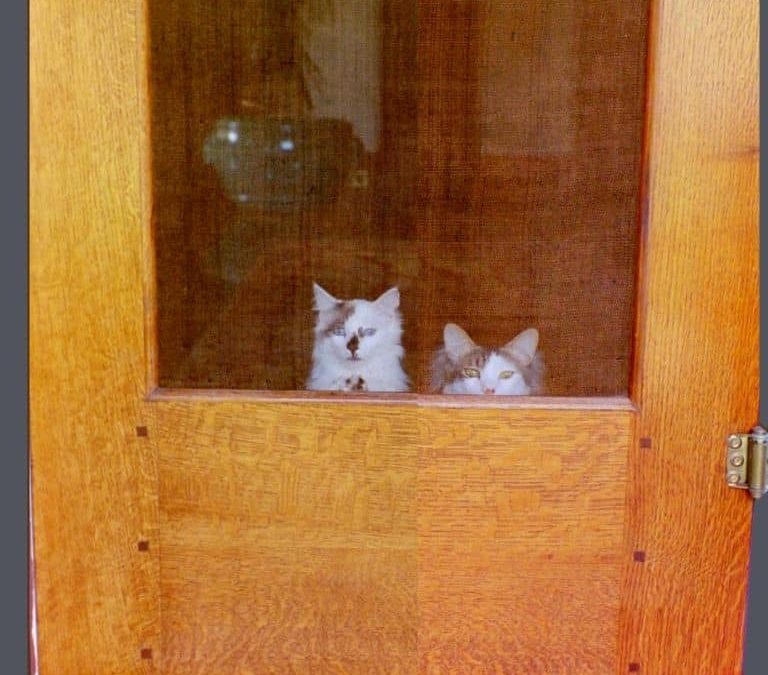
Doo, doo, doo, lookin’ out my custom made, tiger oak, square pegged, brass mesh, bungalow screen door.
Meet Mahjong the Amazing Wonder Kitten (furry face on the left) & his bro, Bukhai Thunder, on the right. When you have pussycats, it is a good idea to have a screen door so that they can experience nature without experiencing nature. We had ours at the Hare House custom made out of quartersawn white oak. We hand-picked the wood & chose where it would be placed. The bottom rail is 2 planks, heavily figured in a lose pattern. The top is 1 plank of the same heavy, large figuring. The side rails are less heavily figured. I do not like an object that has too much figuring. I feel like it doesn’t give you the opportunity to focus & can end up looking like porcupine with bedhead.
Our bungalow screen door is joined by mortise & tennon but we added decorative plugs of walnut, a darker wood. The mesh is brass, a traditional material. The screen is applied to a rabbet in the front of the door. We finished it with a oil-based poly, probably a floor finish because that’s what we do! We chose not to stain it because this type of finish ambers over time & we knew that it would get much darker.
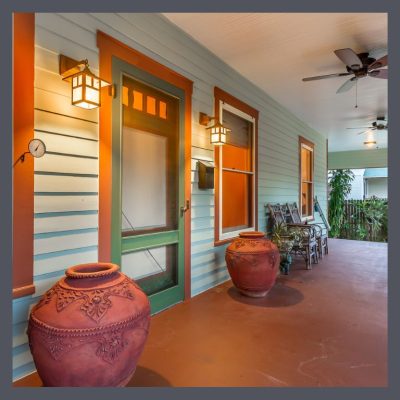
Bungalow doors & screen doors are most often made of a higher grade wood, generally oak, & clear-coated, but sometimes both are painted. You want them to have the same finish.
My Tampa house had a Victorian looking door when I bought it & we replaced it with a pine door that I zhuzhed up with way too many colors. I then got a salvaged screen door that had already been painted, & chose for it also, one of the way too many colors on the door, as well as adding some pieces to stabilize it. It was not as heavy as my oak screen door, & was already 100 years old. The poor door was always a bit wobbly & I was a little concerned the one time I told someone, “Don’t let the screen door hit you on the a$$,” but it was really appropriate at the time. I expect the chunky oak at the Hare House one will hang in there for another 100 years.
For the oak, we chose heavy, reproduction brass hinges & pull. For a lock, I used a simple hook & eye inside. I used a vintage reproduction doorknob on the painted pine screen door, but the oak is rather chunky & the knobs tend to be rather delicate, both in look & in function. The good thing about the knobs is that they do have a locking mechanism & if you make friends with your hardware specialist, she will teach you how to keep them operational.
The hinges have a spring in them that you can calibrate to customize the strength of the door swing so that they will be easy to open, & will self-close without whacking you. You have to fool around with them for a bit to figure out the swing pressure. And then calibrate the second one so that you don’t have a wobbly door.
It is not difficult to build a beautiful screen door. My YouTube channel has many videos about the care & feeding of bungalows. You (or your carpenter/handyman) can learn how to make an authentic screen door here.
THE BEST PART OF A BUNGALOW SCREEN DOOR- THE CAT!
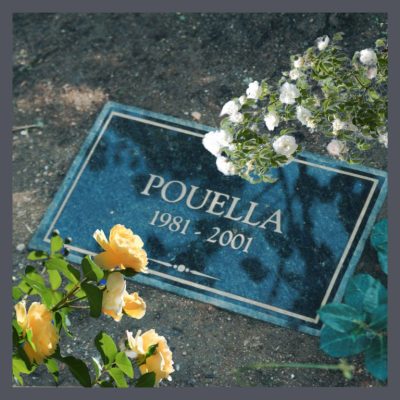
My elderly Pouella moved into the Hare House with us, got to see the beginning of the third millennium on the lap of a dear friend devoted to kitties, & is now buried in the garden under the David Austen roses with a little kitty-cat plaque. She had been sliding downhill fast & I asked her to please hang on until Home Tour so that I could help pull off this important neighborhood event. The day of Home Tour came. She could not rise from her little nest on the floor. She very clearly said, “Ok, Mom. I made it to Home Tour day. Now, can I go?” We zipped her over to the vet & her beloved Daddy, my wonderful husband held her as she drifted away.
At Home Tour everyone asked about her. Not wanting to ruin the committee’s day, I told them all that she was just fine. Home Tour saved me. I got to spend the day with my dearest friends at my favorite activity & the joy of the event buoyed me for going home to no Pouella.
After a period of mourning, during which I moved numbly about my house all day, crying much of the night, one day I woke up, strangely free of the grief that had held me. New kitten day had miraculously dawned! I called my friend Joanne who at Pou’s memorial service, had offered to come with me to choose the newbie and she was at my door in about 3 minutes. (One of the beauties of neighborhood activism- all your friends live real close!)
THE NEW BUNGALOW KITTY
We trotted into the Pasadena Humane society & there he was- 2 lbs. of wild man- my bouncing, squeaking (He never did develop a proper meow.) cage rattling, blue-eyed boy, who had arrived that morning from foster care. The facility was closing soon, so I couldn’t adopt him that day. We stayed playing with him until sternly asked to leave. I was emphatically told that it was first come, first served, so I should be sure to come early.
They opened at 9 the next morning. I had been there with my carrier since 7. When the first volunteer arrived at 8:59, I ran at her yelling, “See, I’m here first. He’s mine!!!!”
He truly was. I brought him home to the Hare House & locked us in the study, the smallest room in the house, so he could get accustomed to his new surroundings. This tiny bundle of fur sniffed the entire floor- rugs, chair legs, fireplace, bookcase, with his tiny super-vacuum nostrils. Satisfied, he hopped up on the desk, speed dialed a couple folks, & sent a fax. Then he looked at me, hopped down & sat by the door, craning his little neck to look up at the doorknob, squeaking. And squeaking. And squeaking.
Later that day, tired from exploring the whole house, he purred on my bosom. I told him, “Thank you for mending my broken heart.”
He answered, “Thank you for mending mine. I missed my mother.”
He had been in foster care for several weeks getting enough weight on him to be adopted. One of the great mysteries of my life is how the foster mom could have given him up.
I guess it was so that I could wake up one morning, from blocks away, hear his tiny squeaks for “Mom!” causing my grief to melt away, & fall in love with this amazing individual who enchants everyone he meets.
He inspires me every day with his joyous spirit, unflagging persistence & creative intelligence. And when we moved to a new house in Florida, he got a new bungalow screen door- one with a shorter bottom rail so he could see over it without having to stand up like a prairie dog. “Thanks, Mom.”
TIP: READ ABOUT BUKHAI THE BIGHEARTED BUNGALOW CAT HERE.
STAY IN THE BUNGALOW KNOW!!!
Sign up for our newsletter & receive our FREE E-book, 7 VITAL Things to Do Before You Hire a Contractor.
IT’S ALL ABOUT THE CHEMISTRY- LEAD PAINT IN BUNGALOWS
Yes, there is lead paint in bungalows. Let’s understand it & learn how to deal with it, better.
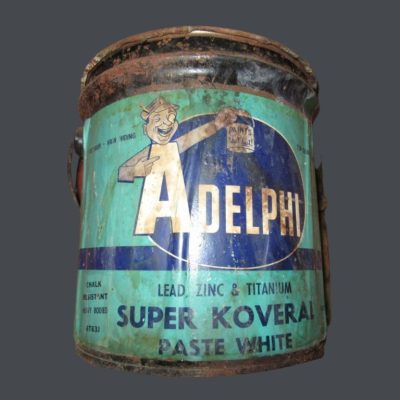
White lead, produced by corroding lead with vinegar, was used in historic paints to produce opacity thereby preventing the sun’s damaging rays from hitting the surface of the substrate. In addition, it was employed to decrease drying time & to increase durability. White lead also helped prevent the growth of mold & mildew.
In the early 1900’s, an effective substitute, titanium dioxide was developed & patented, but, the lead industry continued to mine & recommend lead, so we have lead on the walls of in our old houses & in our plumbing pipes. I have no children, so I am everybody’s mother. It hurts my heart to think of the children whose potential was & is still being diminished by their exposure to lead paint. (It’s my blog & I’ll cry if I want to.)
This charming little booklet, published in 1923, features the Dutch Boy on the cover, talking to the lead soldier. Inside there are 14 images of items that use lead such as a light bulb (lead glass), shoes & baseballs (lead in the rubber), & a bullet which we know is made of lead. A “Color Harmony in the Home” booklet is attached for adults. This coloring book for children was part of a campaign by the lead industry, portraying lead as a healthful element, necessary for a happy life.
The hideous truth is that lead’s toxicity was recognized & recorded as early as 2000 BC. Historians believe that the high exposure to lead, heavily used as a preservative, was a contributing force to the decline of the Roman Empire. In Germany, 1696, a decree was issued forbidding the use of lead-based additives in any wine product. The punishment for anyone who was discovered to have added it was death!
In 1763 Benjamin Franklin, wrote about the “dry gripes” (colic) and “dangles” (wrist drop) which affected painters, typesetters & tinkers, who went from house to house repairing household items made of metal. You can read his letter to a friend, both horrible & fascinating, about the ill effects of lead that he had both experienced & observed, here.
In “A Small Star in the East,” Charles Dickens, an astute observer of the damaging effects of the Industrial Revolution, wrote about the terrible results of lead poisoning on the poor women who worked in London’s white lead mills. “Her brain is coming out her ear & it hurts her dreadful…” 1868.
In the 18th, 19th & 20th centuries it was well known that to work in an industry where you handled lead was going to make you sick or even kill you. However, here in the United States, the lead industry fought fiercely to quiet, even intimidate, researchers & doctors who reported on or identified lead as a hazard. In 1867, the first prepared or “ready mixed” paints in the United States, were developed, spreading the lead danger to the people who worked in the paint plants, & on their dusty work clothes, to their families at home.
Lead was banned from house paint in Australia in 1914. That same year, childhood lead poisoning was first reported in America. However, lead wasn’t banned for use in paint in America until1978, a full generation later. And that’s why there’s lead paint in bungalows. Gack!
WHY AM I TELLING YOU ABOUT LEAD PAINT IN BUNGALOWS?
Because the first people that I ever knew to renovate an old house had a baby. Mom was pregnant during the work & when she delivered, it was tragic. I am not going to describe the situation to you any more than this, but it affected me profoundly. The baby was tested for heavy metals & she was off the charts for lead.
Many of you will be hiring painters. Lead paint disturbance is highly regulated by the EPA, but it is also highly disregarded as a hazard, because some people don’t care about mothers & babies & mitigation can drive costs up. I urge you to be willing to pay the higher expense of hiring a painter who does care about mothers & babies, & is certified (by the EPA) to test for & handle lead. The EPA lead booklet, Renovate Right, which will provide guidance for you, can be found here.
Another EPA booklet, Fight Lead Poisoning with a Healthy Diet explains how you can help your children by providing them with good nutrition. It tells you to keep them well fed because children with empty tummies absorb more lead than children with full ones. It advises you to serve foods rich in iron, calcium & Vitamin C which can help protect children from lead poisoning. It provides lists of foods with these nutrients.
THE EPA also offers recommendations for lead test kits. There are techniques & tools that can be used in handling lead. If you live in a house built before 1978, you should assume that you have some lead paint in your house. You might want to perform lead testing in your bungalow.
If you use a pro to paint, I am suggesting strongly that whomever you hire is trained & certified by the EPA to perform lead testing. They will give you a copy of Renovate Right.
WHAT IS PAINT?
Pigment, Binder & Vehicle
Paint is a dispersion, a mixture in which fine particles of one substance are scattered throughout another substance. It contains small solid particles, usually crystalline, (describing a substance in which the constituent atoms, molecules, or ions are arranged in a regular, repeating three-dimensional pattern) in a liquid medium. When it is applied to a surface, it dries to a solid, protective film, which enhances the beauty of the object to which it is applied.
Pigment
The pigment is the part that we usually care about the most- the color. However, it also has the job of making the paint opaque, blocking ultraviolet light, which causes deterioration to the substrate (an underlying layer or substance.) You have seen old buildings covered in flaking paint whose wood is clearly dried & deteriorating. It’s not protected.
Coloring pigments were also added. Originally, these colors were from natural sources but expanded in range & materials as chemists created more hues.
Binder
For oil-based paints, linseed oil, a colorless to yellowish oil obtained from the dried, ripened seeds of the flax plant (Linum usitatissimum), was frequently chosen because it is a drying oil. It causes the paint to darken over time, which is why Jane Powell always hollered about the use of white-white paint. It’s just not a historic possibility!
Vehicle
The fluid component was termed the vehicle, or medium, because it carried the pigment. Historically, vehicles included turpentine in oil paints. Linseed oil paint was often thinned with an organic solvent, such as turpentine for easier spreading & the enhancing of its drying speed.
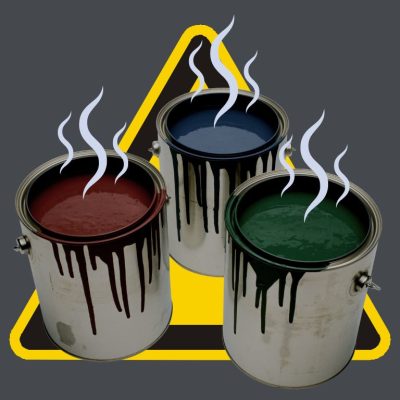
Recently, people have become more generally aware of the dangers that these chemical pose. We use latex paints which, while they may not contain lead, release fumes containing a variety of chemicals, some of which may have short- & long-term adverse health effects as they dry & cure which can take some weeks. The fumes are produced by Volatile (easily evaporated at normal temperatures) Organic Compounds (organic compounds are generally any chemical compounds that contain carbon-hydrogen bonds.)
MORE THAN JUST LEAD IN BUNGALOW PAINTS
Modern paints are far more complex chemically than early paints. Additional ingredients have been added to the simple 3-part system of pigment, binder, & vehicle. Different paints have different chemical make-ups. The actual gases depend on the formula of the paint. Usually, the greater heavily tinted & glossy the paint, the more VOCs are released.
Be aware that even today, there are other chemicals in paint that are hazardous. Make sure that you follow all the safety instructions- PPE, ventilation, clean-up & disposal- that are suggested by the manufacturer. Here’s an article on how to read a Safety Data Sheet. Encourage your painter to do the same. Yes, he may grumble, but if he hears it enough, he just might listen. Here are some videos that will provide you with an orientation to the use of PPE as suggested in the Safety Data Sheet.
There are low & no-VOC options & more are being formulated all the time because of public demand. I’m going to start researching them, so stay tuned.
IF YOU HAVE MISSED ANY ARTICLES IN THE COLOR SERIES, IT”S NOT TOO LATE TO GO BACK!
Part 1, THE COLOR LESSON
How to combine colors on your bungalow to most enhance its features.
Part 2, COLOR HARMONY
Combining colors to please the eye.
Painting your house, particularly the exterior, can be a daunting task. It seems pretty easy, until the paint starts peeling off in sheets, or fades after the first year or alligators worse than a reptile farm. Your hours of prep & application turrn into a fruitless exercise & all the $$$ that you spent evaporates.
Ben has it all figured out. You don’t have to go through the heartbreak. Ben will gladly teach you what you need to know before you pick up your brush.
This is not a DIY site, so, if you are hiring a painter, it’s good to know about the materials that they will use. It’s also good to know what the best practices are so that they will be used by your painter. One of their customer service guys diagnosed my failed paint job- after it had failed. Had we chatted prior to the bozo painter painting, I would have known what to be alert for, & saved myself much grief.
Ben has created an abundance of valuable videos. I have curated the ones most pertinent to old houses. Because of the quantity of the videos, I’m going to skip descriptions. The titles pretty much let you know what they’re about. I thought I knew everything about paint, but I have learned plenty from these videos.
HER-R-R-RE’S BENJAMIN!
How To Fix 5 Common Painting Mistakes (3:18)
Benjamin Moore
How to Choose the Best Paintbrush for Interior Projects (2:55)
Benjamin Moore
How to Touch Up Paint (2:32)
Benjamin Moore
Choosing the Right Paint for your Walls (3:03)
Benjamin Moore
How to Clean & Store Paint Rollers (2:22)
Benjamin Moore
I also suggest reading the series of articles that I wrote on appropriate paint colors.
STAY IN THE BUNGALOW KNOW!!!
Sign up for our newsletter & receive our FREE E-book, 7 VITAL Things to Do Before You Hire a Contractor.


 Doo, doo, doo, lookin’ out my custom made, tiger oak, square pegged, brass mesh, bungalow screen door.
 Bungalow doors & screen doors are most often made of a higher grade wood, generally oak, & clear-coated, but sometimes both are painted. You want them to have the same finish.
 My elderly Pouella moved into the Hare House with us, got to see the beginning of the third millennium on the lap of a dear friend devoted to kitties, & is now buried in the garden under the David Austen roses with a little kitty-cat plaque. She had been sliding downhill fast & I asked her to please hang on until Home Tour so that I could help pull off this important neighborhood event. The day of Home Tour came. She could not rise from her little nest on the floor. She very clearly said, “Ok, Mom. I made it to Home Tour day. Now, can I go?” We zipped her over to the vet & her beloved Daddy, my wonderful husband held her as she drifted away.
 We trotted into the Pasadena Humane society & there he was- 2 lbs. of wild man- my bouncing, squeaking (He never did develop a proper meow.) cage rattling, blue-eyed boy, who had arrived that morning from foster care. The facility was closing soon, so I couldn’t adopt him that day. We stayed playing with him until sternly asked to leave. I was emphatically told that it was first come, first served, so I should be sure to come early.
 STAY IN THE BUNGALOW KNOW!!!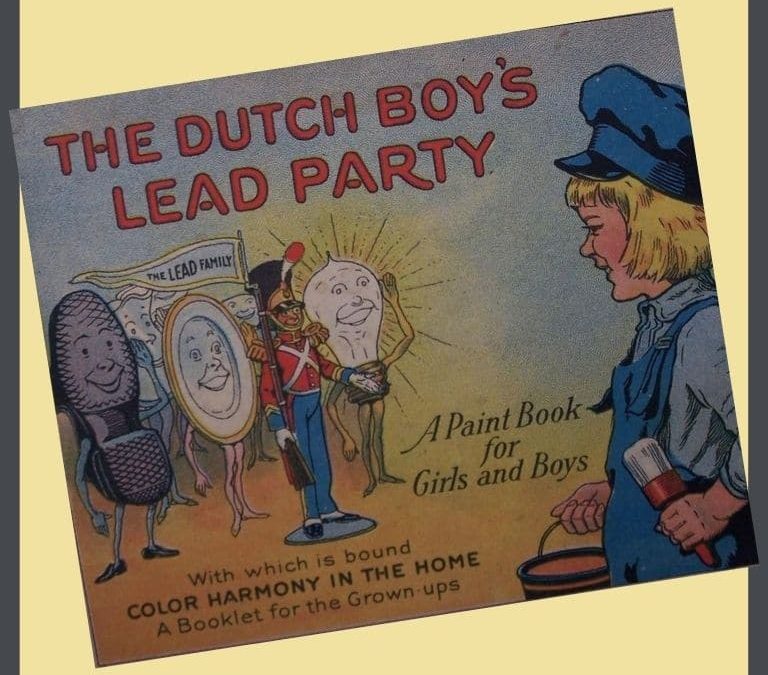
 Yes, there is lead paint in bungalows. Let’s understand it & learn how to deal with it, better.
 In “A Small Star in the East,” Charles Dickens, an astute observer of the damaging effects of the Industrial Revolution, wrote about the terrible results of lead poisoning on the poor women who worked in London’s white lead mills. “Her brain is coming out her ear & it hurts her dreadful…” 1868.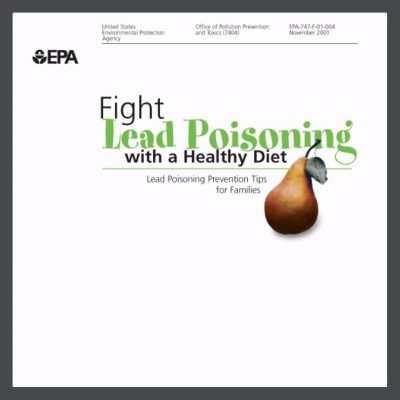
 Pigment, Binder & Vehicle
 Modern paints are far more complex chemically than early paints. Additional ingredients have been added to the simple 3-part system of pigment, binder, & vehicle. Different paints have different chemical make-ups. The actual gases depend on the formula of the paint. Usually, the greater heavily tinted & glossy the paint, the more VOCs are released.
 Part 1,
 Painting your house, particularly the exterior, can be a daunting task. It seems pretty easy, until the paint starts peeling off in sheets, or fades after the first year or alligators worse than a reptile farm. Your hours of prep & application turrn into a fruitless exercise & all the $$$ that you spent evaporates.