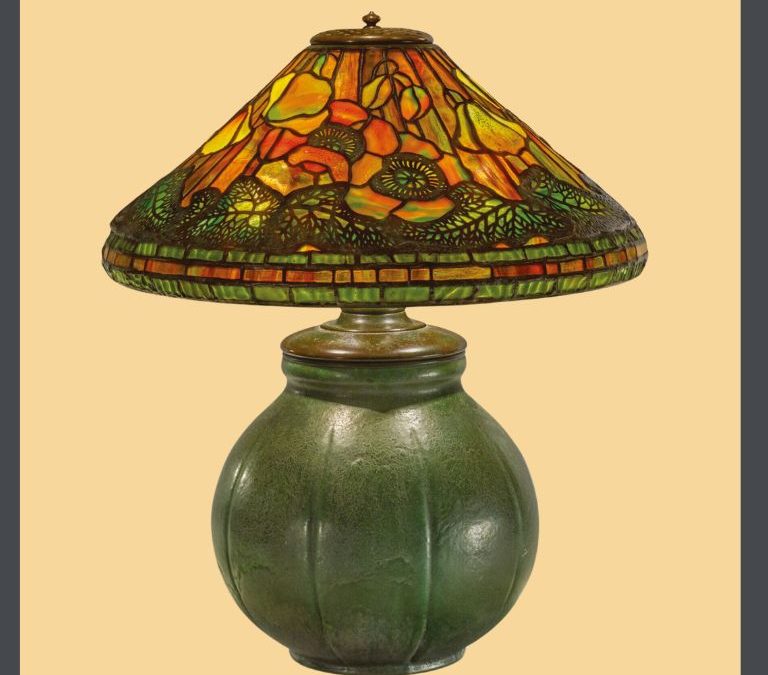
There were many women who were involved in the making of Arts & Crafts lighting. For example, at Grueby, a pottery manufacturer which often partnered with other designers such as Stickley & Tiffany to make lamps, male potters formed the clay & women painted it. Newcomb Pottery, which also made lamps, was founded in 1895 as an educational experiment of H. Sophie Newcomb Memorial College (Tulane University’s former women’s college) in New Orleans. The quasi-commercial program provided an opportunity for Southern women to support themselves financially during & after their training as artisans.
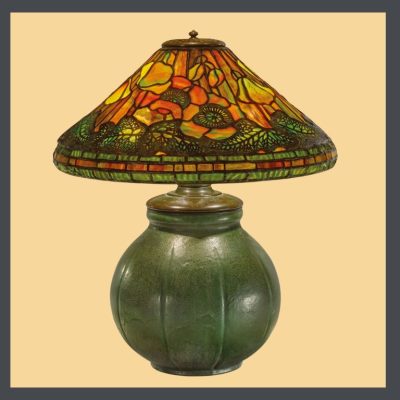
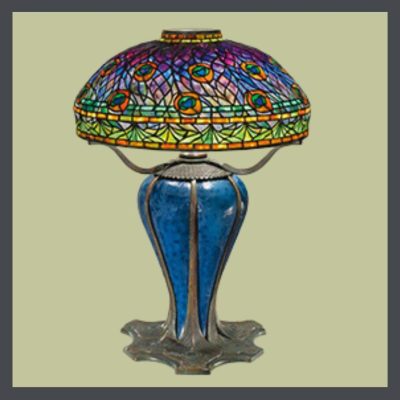
One hundred years later, the immense contributions of women at Tiffany are finally being recognized. The nearly unknown “Tiffany Girls” designed & created lamps & lampshades including many of Tiffany’s most beloved pieces. The base of this exquisite piece was created by Grueby & the shade by Tiffany.
In this article, I want to focus on two women of Arts & Crafts lighting, Lillian McNeill Palmer & Elizabeth Eaton Burton because I am very fond of their work. Both display a distinct femininity that is lacking in the work of their male counterparts.
LILLIAN McNEILL PALMER
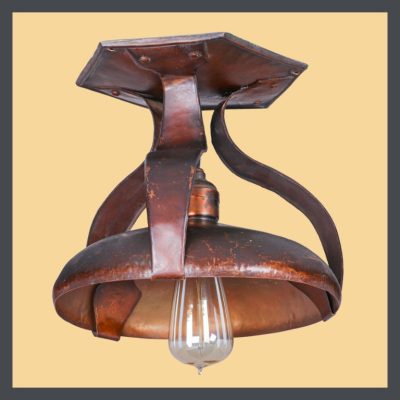
Palmer & Van Erp, both being metalsmiths, were rivals, with Palmer stealing artists from Van Erp, even his own nephew! (Perhaps this explains why Van Erp refused to teach anyone, even his family about how he created his finishes!)
In the 1900s, Palmer worked as a writer & editor for the Mercury Publishing Company which seems to have focused on Theosophical matters, & started gaining an interest in Arts & Crafts metalwork, creating a metal working studio in her parents’ basement. From there she started her business of making & marketing light fixtures.
Both she & Van Erp (& many others) took advantage of the opportunities created by the 7.8 magnitude quake that struck San Francisco on April 18, 1906. For 3 days fired raged over the city, turning almost 300,000 structures to ash. The rebuilding that occurred afterward provided an economic boon to those involved in construction & to those providing decorative embellishments for the home, including Palmer who was among the first recorded metal artists using copper, lead & brass.
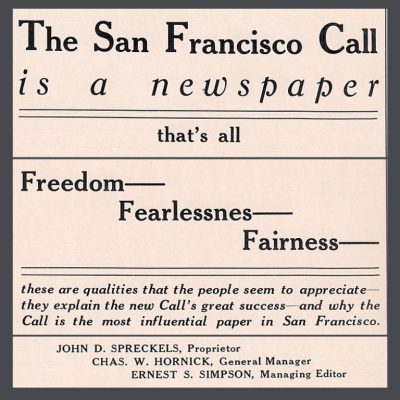
A year later, she was featured in the San Francisco Call who dubbed her an “Ingenious Girl Worker in Metals.”
The next year, 1908, Palmer traveled to Europe & Asia to learn more about the Arts & Crafts aesthetic. She took courses in metal crafting & electrical design in Vienna & later, back in the United States, she studied power-efficient lighting & the new science of lighting placement to reduce eye strain. In 1910, she opened the “Palmer Copper Shop” in San Francisco. She expressed her work as, “designing fixtures that not only attain the desired lighting effects in a given room, but also conform to the style & contour of the room & the usage to which it is to be put,” clearly utilizing the new knowledge & skills that she had absorbed in Europe.
When metal became scarce with the beginning of World War I, she again drew on her experience & education, becoming active in many California women’s clubs, speaking on topics such as “Electric Lighting of Dwellings from the Standpoint of Health, Economic operation, Science & Ornament,” “Starting in Business with Ninety Cents & No Experience,” “Housewives Learning to Wield, Saw & Hammer,” & “Women as Builders of Business.” She was able to return to metalworking in 1931 to resume her place as one of the iconic women in Arts & Crafts lighting.
Check out my Pinterest page on Lillian Palmer to see more of her stunning work.
ELIZABETH EATON BURTON
Burton’s prolific work speaks to my heart. I can easily imagine her working in her Santa Barbara studio, gracefully executing her designs, choosing her shells, carefully placing them in the metal & finally inspecting the illuminated lamp, admiring its warm glow.
There is an ease to her work that I believe came from growing up as the daughter of an artist, Charles Frederik Burton. Like May Morris, her life was filled with the creating of art & beauty from its earliest days. She was clearly influenced by her environment- the sea providing her with both materials & inspiration for her lamps.
She is most well known for her hammered & repousséd copper lamps & sconces in floral motifs set with shells. But, after establishing herself in the Southern California art scene as a woman in Arts & Crafts lighting, through exhibiting in art shows & craft fairs, she also began making unique woodcuts, watercolors, book bindings, tooled leather décor, screens & stained glass. A great deal of her work is unsigned but being unique in design & meticulously crafted, it is not difficult to identify.
My Pinterest page displays many more examples of her work. Please give yourself a treat & visit there!
This article is one in a series about lighting in the Arts & Crafts period. Make sure that you read them all !!
There was a great deal of lighting manufactured 100 years that doesn’t come with a designer name & a designer price tag. (An authentic Tiffany, as an example, can set you back a cool $2,000,000.) For anyone not living in a Greene & Greene or other bungamansion, this lighting is beautiful, highly appropriate & will complement the other features of your home. Some of the shops listed below are online sources & some are brick & mortar, which sell online also.
Before I begin, let me mention that salvage shops are wonderful sources of old lighting fixtures & may also have some table & floor lamps. They can also be found at antique stores, mostly those specializing in A&C. I have also done well on eBay & Etsy though I have received pieces that were not as represented.
Even if you are not in the market for lighting, please visit & browse these sites, read the stories & admire their merchandise. The proprietors of these businesses have all devoted decades to learning about, collecting, restoring & selling lighting. Just looking at their pages will provide you with a wonderful education on the Arts & Crafts aesthetic.
HERE’S THE LIST OF ANTIQUE ARTS & CRAFTS LIGHTING RESOURCES
I’m going to start with the Facebook group, Antique Lighting Collectors which has some 30,000 members. The group offers some wonderful images of unique & rare lighting pieces, information on antique lighting, cleaning, repair & supplies & in general, provides great community for anyone who loves antique lighting. (That would be me!)
They do allow buying & selling of lamps. I offer you the warning, know before you go. Perform your due diligence in establishing the authenticity, condition & value of the piece before you buy.
Heck, make sure that the piece & the seller actually exist!
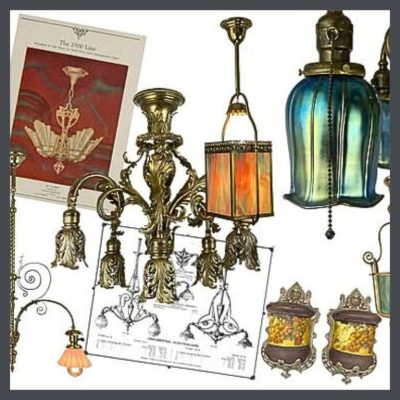
A lovely collection of old fixtures from 1840-1940, that have been painstakingly restored with upgraded hardware & rewired to current code. He can also change a gas fixture into an electric one. In most cases they use antique shades, however, they also stock gas & electric shade reproductions.
They buy from other dealers who are not equipped to perform restoration work, nor have the skills. Their work is meticulous, honoring the age of each piece.
Carrying lamps from all periods they have some great A&C fixtures. Their selection of kitchen lighting is extensive, varied & whimsical. I follow them on Facebook & greatly enjoy seeing their changing inventory.
Their website clearly lays out their policies & practices, from shipping to returns. They do have a storefront, open by appointment in Boston.
The shop is in Canada (Toronto) & I know that most of you are in the United States. I have no clue as to how the American dollar is currently performing in Canada, nor do I know what shipping would be to your bungalow in Hometown, USA, but you need to at least visit their page & experience this lighting!
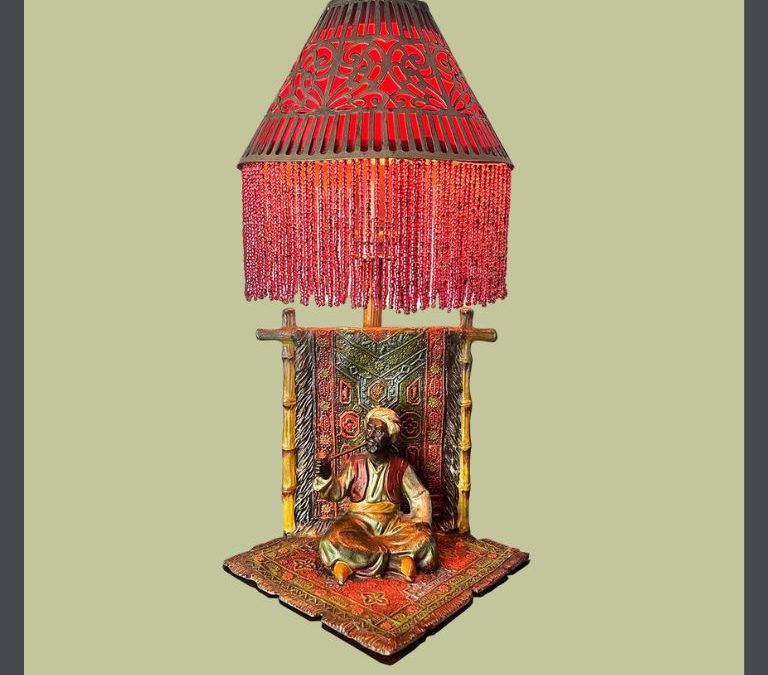
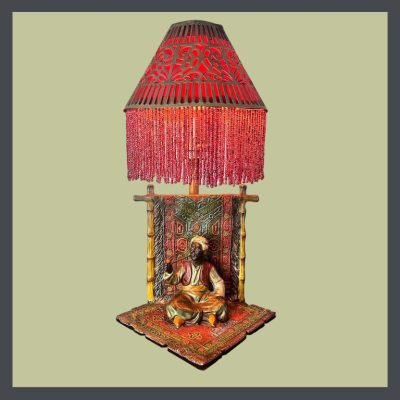
If you’re venturing up that way, stop in at their glorious showroom & feast thine eyes. A prime example, this lamp is one of the coolest I have ever seen. Made in the early 1900’s in Austrian, these figural lamps were made of bronze or spelter (an alloy in which zinc is the main constituent) & were often painted as the metal was cooling, creating a an enamel like finish. I love the red silk shade with its open work pierced detail & original beaded trim. Rewired & ready to enjoy, I’d use it in my bungalow in a heartbeat!
They also have a collection of new lights that are available in 5 different finishes, some of which would be appropriate in a bungalow. For those of you nearby, they perform complete restorations & rewires as well as & repairing & recovering lampshades. Its goods & services make it truly one of the finest antique Arts & Crafts lighting resources.
I think that these folks have an incredible selection of all types of lighting- chandeliers, pendants, flush mount, sconces, kitchen & bathroom. They have a small number of table lamps.
They also carry parts such as shades, candle covers & other components & perform lighting fixture repair.
Their selection of hardware is extensive- door hardware, reproductions of antique originals, door knockers, thresholds & kickplates, doorbells, locks, mailboxes & mailslots.
Sadly, the brick & mortar facility & museum are closed due to staffing shortages but they are still selling online & will respond to your call or email.
A sweet collection of lighting from 1890-1930, they follow Morris’ dictum, “If you want a golden rule that will fit everybody, this is it: Have nothing in your house that you do not know to be useful, or believe to be beautiful.”
They offer ceiling lamps, wall sconces, porch lighting, slip shades. & some table lamps. Worth noting is that they have some of the most appealing A& C lighting I have ever seen!
They have a far larger inventory than those shown on the website, which is mid-upgrade. If you need a lighting fixture for your bungalow, give their knowledgeable, friendly proprietor Patrick a ring or an email & he’ll show you his abundant wares.
Check out my Pinterest page of their A&C lighting for more items, some available, some sold, restored & some not yet. These lights will provide you with the best education on A&C lighting you could get anywhere!
WHO ARE YOUR FAVORITES, PLEASE?
These are mine, but I am certain that you have discovered many others. I’d like to hear from you & learn whose lighting illuminates your bungalow. Drop me a line!
THIS IS JUST ONE PART OF AN IN-DEPTH SERIES ON LIGHTING
Jane Powell used to joke that the Arts & Crafts Revival has lasted longer than its original period of popularity. Although I am ever pining for my time machine, it gives me joy to know that there are many talented craftsman working in the style today, including these modern day Arts & Crafts lighting masters. Thanks to the world of the internet, it is easy to admire & purchase their work.
Ragsdale
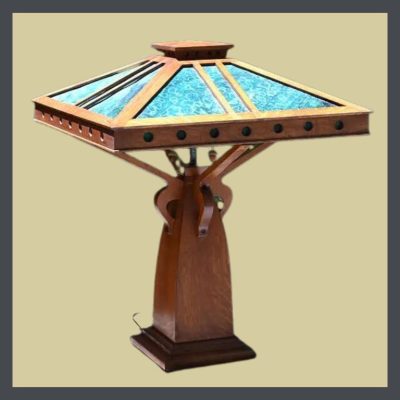
Mission Style Oak & Mica Lamps & Lighting
“The Arts & Crafts lamp or Mission Style design is meant to capture the essence of old-time lamp makers and bring the art up one level.”
Craftsman Phillip D. Myer built his first Arts & Crafts style lamp in 7th grade woodshop & soon had a little craft show stand where he created Frank Lloyd Wright inspired items. 20 years later he began designing & drawing furniture seriously, & then started his first full time wood shop & studio & gradually, coming full circle, Arts & Crafts lighting became his main focus. Says Phil, “I spent many years living in the details of designing the 33 lamp designs I now do.”
Phil creates his lamps from quartersawn white oak, also termed “tiger oak.” This wood is obtained by slicing a log of high grade (few flaws, knots, etc.) into quarters & then cutting the boards to show the flame shape grain.
Years ago, he used to spend hours at the mill, hand-picking the heavy boards, searching for the flame, choosing only a small fraction of them & tossing the rest back into the pile. The mill owners objected to his taking the best pieces & he gladly offered to pay them a higher price for the better quality material. However, he never stopped searching for the most beautifully grained wood & today buys from a mill that provides lumber with the most pronounced & exquisite graining obtainable.
The light glows through authentic mica a naturally occurring mineral, which was originally mined near Asheville NC & stained glass, crafted in the U.S.
In 2010, Phil’s lighting was honored by being accepted by the Roycroft Copper Shop in the Roycroft Campus in East Aurora NY, placing his work on the same campus where Elbert Hubbard brought Arts & Crafts to our country.
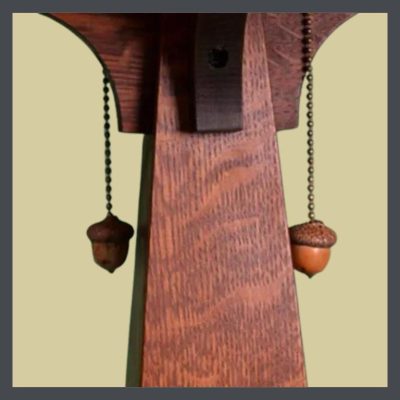
As an extra bonus, Phil offers real acorn pull chains. He searches the forests of Michigan, returning again & again to the trees which produce the most perfectly shaped ones. He hollows the acorns & then fills the little cuties with epoxy to make them strong.
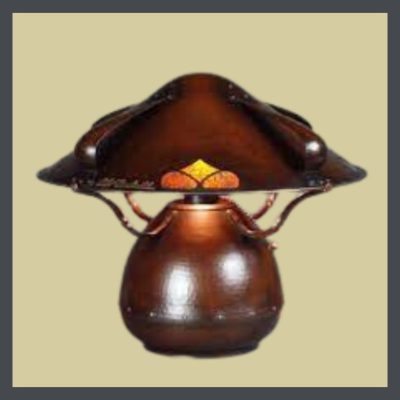
Taught by his father, Luke Marshall became an artisan at 13, crafting silver jewelry & sculpting metal. Later, he met the Spanish grandmaster silversmith, Ricardo Lopez de Grado who refused to teach him, but suggested that he copy his work. De Gardo himself was a descendant of goldsmiths, & his training was guided by his godfather. It was believed that De Grado was the only remaining artist who began a piece from a flat piece of metal, coaxing it into the shape desired with his hammer. Marshall uses this technique to create hollow forms, likely inspired by De Grado. As with De Grado, he also fashions his own tools.
In his mid-teens, when Marshall was told that his work was reminiscent of Roycroft copper, he researched the Roycrofters & “fell in love.” He then saw a Van Erp lamp in a newspaper, copied it & its popularity spurred him to continue making them.
Though he does make reproductions of Van Erp’s lamps, (as well as meticulously repairing lamps made by Van Erp 100 years ago) his pieces are uniquely his own, with every hammer strike bearing his signature touch. He also crafts his own designs, & offers custom work. As well as lamps, Marshall makes lidded copper boxes with highly detailed, applied relief.
Master glass artist, Carl Radke has been creating magnificent hand-blown luster glass lighting for 45 years. Lusterware contains silver to produce its beautiful sheen & after having first been created by Tiffany in 1881, lost favor in the mid-20’s.
In the 1970’s Radke helped inspire the Renaissance of American glass art, during a period of increased interest in the crafts. Please read more about this art form & its interesting technology here.
He also creates Arts & Crafts glass shades to fit your own lamps.
WHO ARE YOUR FAVORITES?
These are only three of the masters working in America today. No doubt there are some creating incredible lighting in Europe. I’d like to hear from you & learn whose lighting illuminates your bungalow.
THIS IS JUST ONE PART OF AN IN-DEPTH SERIES ON LIGHTING
LET’S TAKE A LOOK AT SOME REPRODUCTION ARTS & CRAFTS LIGHTING RESOURCES
If you should feel more comfortable with modern light fixtures, below are some good reproduction Arts & Crafts lighting resources for you. I have chosen companies with longevity & good reputations. I always encourage my readers to perform their due diligence- check reviews & carefully, read product descriptions & shipping & purchasing/return terms- prior to buying.
I am always in search of quality vendors for my readership. Please let me know if you have any vendors that you would like would like to recommend.
Please read all the articles in this series to learn more about lighting. (All the links are at the bottom of the page.) It is a key design element in a room & can change the perceived size, shape, flow & mood of any space.
The Arroyo Guild of Fellow Craftsman, motivated by the Arroyo Seco, the seasonal river, often dry canyon, is considered to be the birthplace of Pasadena & the inspiration for the Gamble House. In 1909, the Arroyo Guild published its first pamphlet entitled “Arroyo Craftsman” which championed man’s innate need to create beautiful things with his own hands. Honoring these great artisans of the California Movement, Arroyo Craftsman lighting, was founded three-quarters of a century later.
Each Mission, Prairie or humble bungalow style is available in over 100 choices of sizes, finishes, glass, on a base of heavy gauge brass. These American made, fine architectural & landscape lighting pieces, are handmade to your custom order & aged by their special processes to have a natural, vintage appearance, which will continue to oxidize with age & become even more beautiful.
Their extensive catalogue of reproduction Arts & Crafts lighting resources can be accessed here. If you find all the choices intimidating, their designers are most helpful in assuring that you will make the perfect decision for your home. Their website includes links to retailers near you.
You can learn more about the Arroyo culture & view lovely Robert Winter videos here.
I restored 4 houses with their hardware- window hardware, hinges, pulls, knobs, push-button switches (which I highly recommend as a tactile connection to history. I spent way too much time clicking them on & off because I loved the sound & the sensation.) I also installed their lights in my bathrooms after rescuing them from various stages of hideousity.
This company demonstrates a profound respect for history, producing authentic, high quality reproductions & offering some original pieces as well. They have supplied hardware & done restorations on many projects for Federal, State, & local properties & have been featured in on television, in magazines & other national media as one of the top reproduction Arts & Crafts lighting resources.
Their Resource Center provides ideas & inspiration, displays the finishes that they offer, shows an informative architectural timeline & best of all, has a glossary of term related to historic hardware.
I have been extremely pleased each time with their products & their service.
No, they no longer produce this bat fixture, but if you look long enough, I’m sure that you’ll be able to find one hovering about on Craigslist or Marketplace or eBay or Etsy!
Rejuvenation began almost half a century ago as an architectural salvage shop in which the owner would restore vintage lighting. To fulfill the demand for fixtures, he began manufacturing reproduction pieces. I purchased a living room 4 arm chandelier & a 2-arm lamp for my 1925 California bungalow dining room in 2004. They looked great but the coolest part was that I was also able to order 4 custom sconces that were newly manufactured to compliment the antique pieces. Unfortunately they no longer create such items, but they do offer several glass & finish options in each style.
Though acquired by Williams-Sonoma in 2011, they still restore antique lighting & assemble their inspired pieces in Portland, Oregon.
Their knowledgeable design crew can help you with your choices.
Revival’s retail store is housed in a beautiful, old 7,000 square foot brick building in Spokane, Washington. Their display of merchandise is truly dazzling & artfully displayed. You can also order online & they will assist you on finding what you need.
This vendor was suggested to me by a reader who is a big fan & they have impressive reviews.
They feature an ever-changing inventory of antique lighting & also reproduction chandeliers, sconces, pendants & table & floor lamps. They seem to have an abundance of items that would be perfect in a bungalow!
Revival offers a good variety of finishes in their repro lighting- old gold, nickel, antique brown, pewter, & polished brass & they do repair also.
Additionally, they have some exceptional furniture. I saw a gorgeous armoire on their Facebook page!
EASIER ON THE BUDGET
Big Box stores & online lighting vendors do have some choices, but my preference is always the high price spread. That being said, it’s not just antique lighting that can be found used. I have seen a fair number of current fixtures on eBay & I imagine you might have good luck on Etsy & Marketplace & Craigslist too. You can put in the names of these manufacturers in the search & see what comes up. There’s also Habitat Restore. I overbought for my bathroom & donated a pricey, custom, multi-light sconce to Habitat.
THIS IS JUST 1 PART OF AN IN-DEPTH SERIES ON LIGHTING
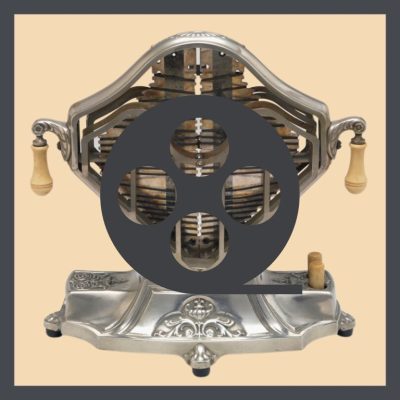
These videos are mentioned in my post, BUNGALOW TOASTERS which I encourage you to read. It includes a video of this little gem, dubbed a “Sweetheart” toaster, being used.
At the risk of becoming very hungry, I encourage you to also watch the magic of the videos of folks as they lovingly use their old toasters. This is a variety of toasters & even a toaster collector with a sense of humor!
One of my favorites is of a full restoration of a poor toaster that looks like it was used hard by a family of 10 & then abandoned when they got an updated model. A talented man meticulously dismantles it, revives each tiny part & lovingly puts it back together again.
I also offer you my Pinterest page of old toasters. I have quite an array!
THE VIDEOS- Antique Toasters
Antique Toastmaster Toaster 1A5 Demo “Automatic Pop-Up Type Toaster” Bachelor Model 1 Single Slice (:50)
Laura’s Last Ditch Vintage Kitchenwares
Would you like your toast medium or well-done?
Toaster Collector (2:55)
Texas Country Reporter
He started with his mother’s toaster & 300 toasters later, he eats jam for breakfast every day.


 There were many women who were involved in the making of Arts & Crafts lighting. For example, at Grueby, a pottery manufacturer which often partnered with other designers such as Stickley & Tiffany to make lamps, male potters formed the clay & women painted it. Newcomb Pottery, which also made lamps, was founded in 1895 as an educational experiment of H. Sophie Newcomb Memorial College (Tulane University’s former women’s college) in New Orleans. The quasi-commercial program provided an opportunity for Southern women to support themselves financially during & after their training as artisans.
 Palmer & Van Erp, both being metalsmiths, were rivals, with Palmer stealing artists from Van Erp, even his own nephew! (Perhaps this explains why Van Erp refused to teach anyone, even his family about how he created his finishes!)
 A year later, she was featured in the San Francisco Call who dubbed her an “Ingenious Girl Worker in Metals.”
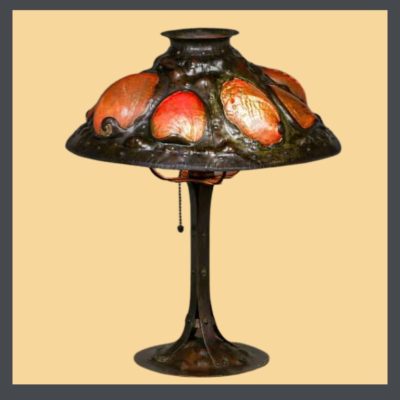 Burton’s prolific work speaks to my heart. I can easily imagine her working in her Santa Barbara studio, gracefully executing her designs, choosing her shells, carefully placing them in the metal & finally inspecting the illuminated lamp, admiring its warm glow.
 Part 1, OUT OF THE DARKNESS
 There was a great deal of lighting manufactured 100 years that doesn’t come with a designer name & a designer price tag. (An authentic Tiffany, as an example, can set you back a cool $2,000,000.) For anyone not living in a
  I’m going to start with the Facebook group,
 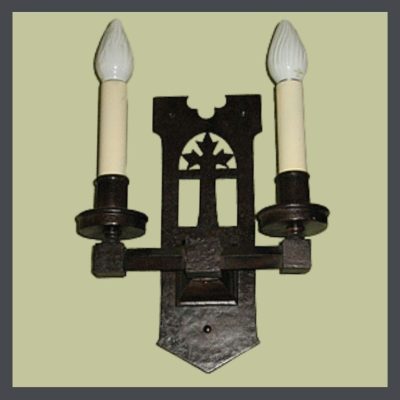 A lovely collection of old fixtures from 1840-1940, that have been painstakingly restored with upgraded hardware & rewired to current code. He can also change a gas fixture into an electric one. In most cases they use antique shades, however, they also stock gas & electric shade reproductions.
 The shop is in Canada (Toronto) & I know that most of you are in the United States. I have no clue as to how the American dollar is currently performing in Canada, nor do I know what shipping would be to your bungalow in Hometown, USA, but you need to at least visit their page & experience this lighting!
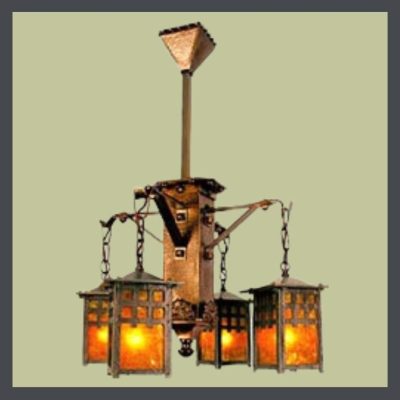 I think that these folks have an incredible selection of all types of lighting- chandeliers, pendants, flush mount, sconces, kitchen & bathroom. They have a small number of table lamps.
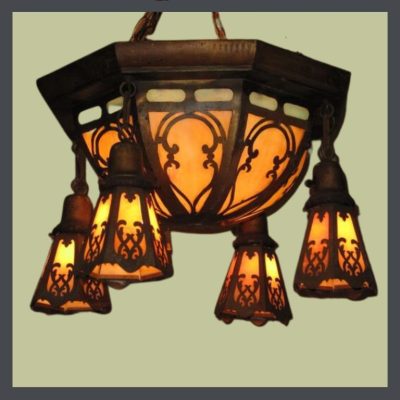 A sweet collection of lighting from 1890-1930, they follow Morris’ dictum, “If you want a golden rule that will fit everybody, this is it: Have nothing in your house that you do not know to be useful, or believe to be beautiful.”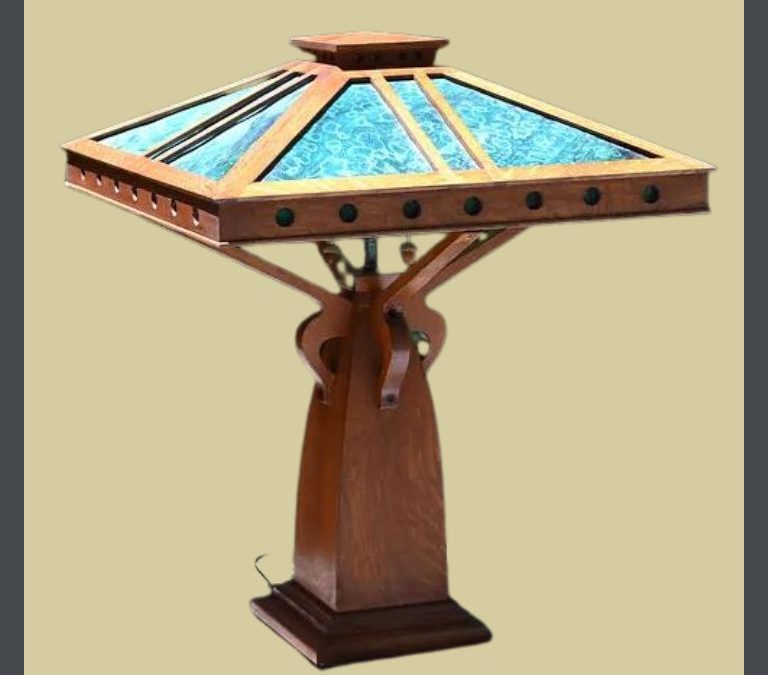
 “The Arts & Crafts lamp or Mission Style design is meant to capture the essence of old-time lamp makers and bring the art up one level.”
 The light glows through authentic mica a naturally occurring mineral, which was originally mined near Asheville NC & stained glass, crafted in the U.S.
 Taught by his father, Luke Marshall became an artisan at 13, crafting silver jewelry & sculpting metal. Later, he met the Spanish grandmaster silversmith, Ricardo Lopez de Grado who refused to teach him, but suggested that he copy his work. De Gardo himself was a descendant of goldsmiths, & his training was guided by his godfather. It was believed that De Grado was the only remaining artist who began a piece from a flat piece of metal, coaxing it into the shape desired with his hammer. Marshall uses this technique to create hollow forms, likely inspired by De Grado. As with De Grado, he also fashions his own tools.
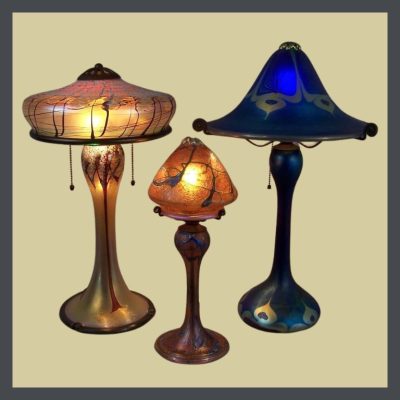 Master glass artist, Carl Radke has been creating magnificent hand-blown luster glass lighting for 45 years. Lusterware contains silver to produce its beautiful sheen & after having first been created by Tiffany in 1881, lost favor in the mid-20’s.
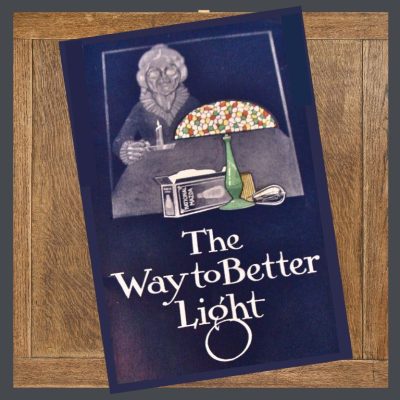 If you should feel more comfortable with modern light fixtures, below are some good reproduction Arts & Crafts lighting resources for you. I have chosen companies with longevity & good reputations. I always encourage my readers to perform their due diligence- check reviews & carefully, read product descriptions & shipping & purchasing/return terms- prior to buying.
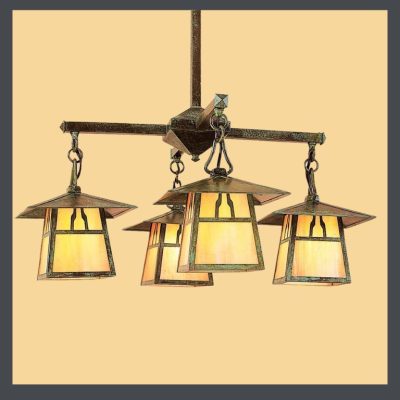 The Arroyo Guild of Fellow Craftsman, motivated by the Arroyo Seco, the seasonal river, often dry canyon, is considered to be the birthplace of Pasadena & the inspiration for the Gamble House. In 1909, the Arroyo Guild published its first pamphlet entitled “Arroyo Craftsman” which championed man’s innate need to create beautiful things with his own hands. Honoring these great artisans of the California Movement, Arroyo Craftsman lighting, was founded three-quarters of a century later.
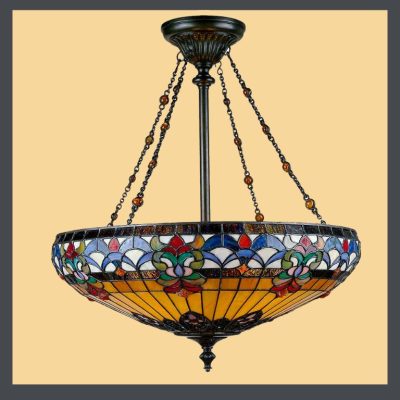 I restored 4 houses with their hardware- window hardware, hinges, pulls, knobs, push-button switches (which I highly recommend as a tactile connection to history. I spent way too much time clicking them on & off because I loved the sound & the sensation.) I also installed their lights in my bathrooms after rescuing them from various stages of hideousity.
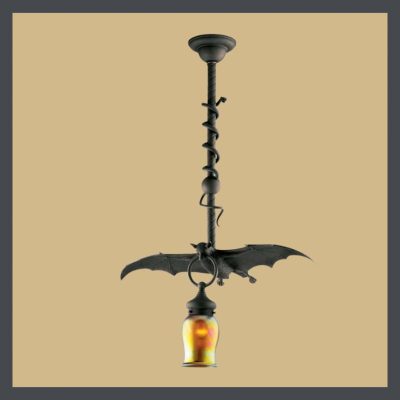 No, they no longer produce this bat fixture, but if you look long enough, I’m sure that you’ll be able to find one hovering about on Craigslist or Marketplace or eBay or Etsy!
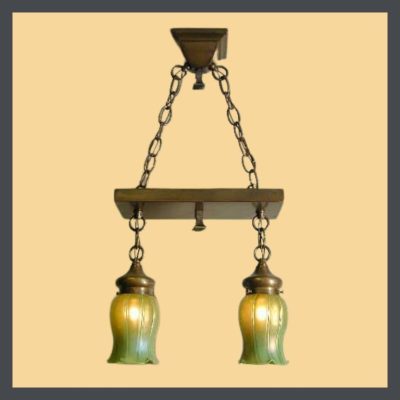 Revival’s retail store is housed in a beautiful, old 7,000 square foot brick building in Spokane, Washington. Their display of merchandise is truly dazzling & artfully displayed. You can also order online & they will assist you on finding what you need.
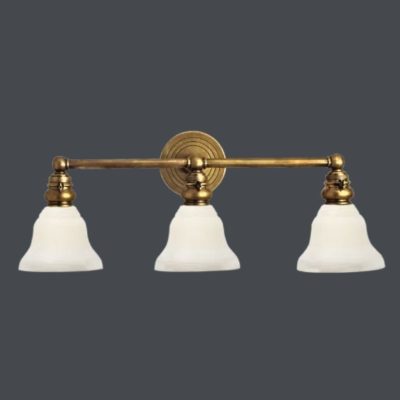 Big Box stores & online lighting vendors do have some choices, but my preference is always the high price spread. That being said, it’s not just antique lighting that can be found used. I have seen a fair number of current fixtures on eBay & I imagine you might have good luck on Etsy & Marketplace & Craigslist too. You can put in the names of these manufacturers in the search & see what comes up. There’s also Habitat Restore. I overbought for my bathroom & donated a pricey, custom, multi-light sconce to Habitat.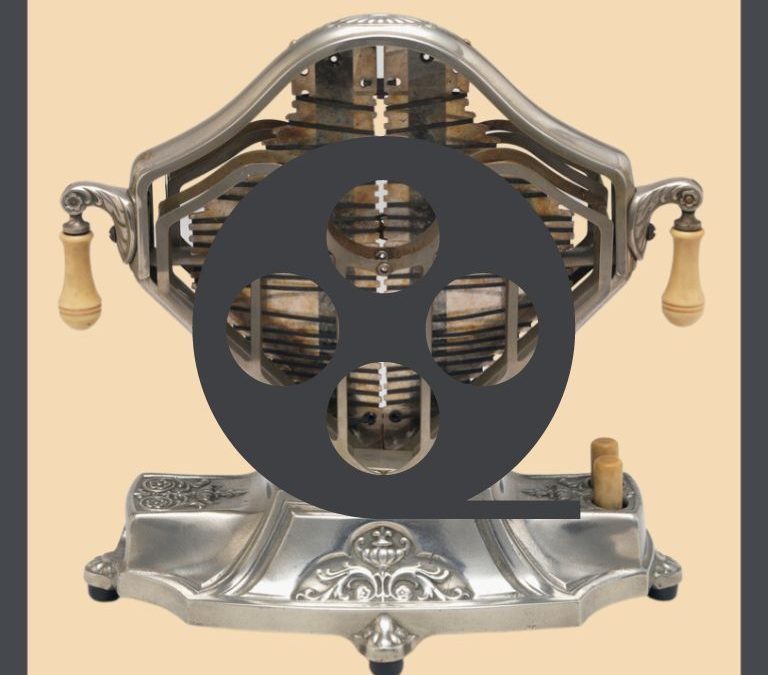
 These videos are mentioned in my post,