This guide of how to clean & maintain your wood floors applies only to floors with a surface coating type of finish such as oil-based polyurethane finish, water based finishes, etc. For floors with penetrating finish, refer to your manufacturer’s instructions.
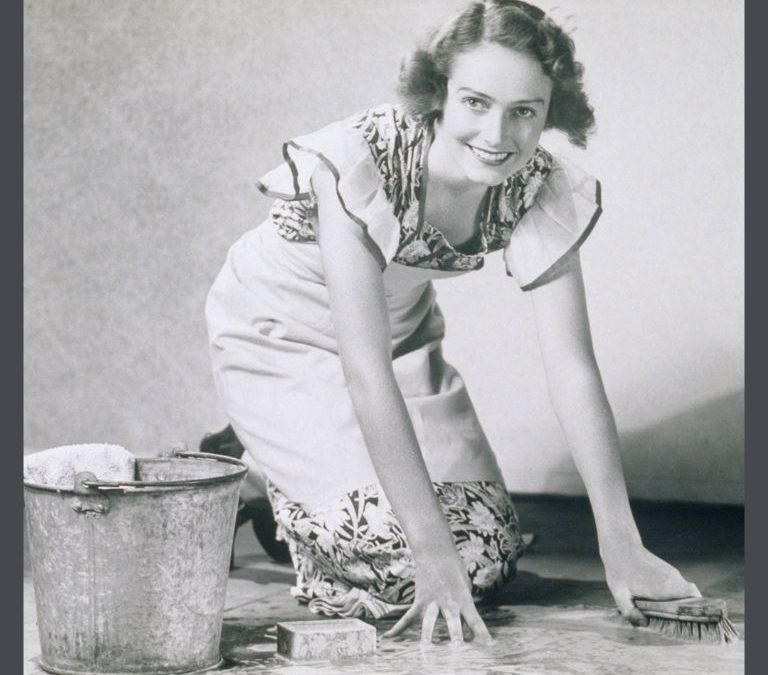
There are some similarities in care between the various finish types, but for the sake of ease, this article pertains to water & oil based polyurethanes only. None of them requires scrubbing on your hands & knees nor flooding the floor with water! Flooring finishes have come a long way since Great-grandmother’s time & the methods of cleaning & maintaining them have evolved right along with them.
There are many choices in flooring finishes today, each one with different care requirements. If you should currently be trying to decide about which finish to apply to your floor, you might want to read this article on cleaning & maintenance, as well as the one on types of finishes. Appearance is not the only consideration unless you have a houseful of staff. I’m guessing that a few of you don’t!
That’s brings the point to mind, this article is a good guide for your housekeeper. I have seen too many floors ruined because a lack of education.
TIPS ON MAINTAINING YOUR POLYURETHANE COATED WOOD FLOOR
1. Avoid high heel traffic, especially heels that have lost the protective little tips on the end. They are deadly to wood floors.
2. Use walk-off mats at all entrances. It’s not a bad idea to remove your shoes before entering your house. It is the tradition in many cultures. In addition to dirt, it also keeps out pesticides & herbicides that might be picked up outside. It also helps you enforce #1 when you have guests & you don’t want to be singling out any one person.
3. Place protectors on the feet of all furniture. You can get them in different types. This is a link to Amazon where you can see the various kinds & even some cute little videos about how to use them.
4. Use area rugs in high traffic areas.
PETS & WOOD FLOORS
Let’s start with our canine buddies.
If Doggie weighs over 30-40 lbs. or is very bouncy, their claws can not only scratch the wood but can actually dent it. Softwood floors like pine or fir, even floors of old growth wood which are harder than floors of newly harvested woods of the same species, are more susceptible to this, but I have seen many dented old-growth oak floors.
Some of my flooring customers used claw tips & found them workable. You can see them on Amazon here. I know little about them & recommend that you speak with your vet or trainer before trying them on your pet.
I also recommend placing rugs beneath the places where Doggie likes to hang out because when they jump down, they can exert quite a bit of force against your floor. If you place the rug part way under the feet of the furniture piece, it will help to anchor it.
There is no finish that will make your floor harder. Wood is soft & porous & though I’m not going to say that it’s a delicate material, it does take knowing what it likes & what it doesn’t like to get along with it.
Kitties are another matter. Firstly, I do not think that there is any way in the world to protect a wood floor from a litter box. There is nothing that you can put under it that will make any difference. Find a floor with an impervious surface. Kitties also seem to like to throw up & their vomit is very acidic. All I can say is that you need to clean it up as soon as possible. You hear the urping sound, grab a paper towel & get it up immediately.
I have never seen a cat scratch a floor, though my Pouella scratched my high gloss dining table. We had a large round metal platter that we displayed in the center, & she used to like to walk around it before settling herself atop the nice, cool dish. After a couple years of this, when you picked up the platter you could faintly see a circle of tiny claw marks. (This was nothing compared to what she did to the couch, but that’s another story.)
CLEANING YOUR POLYURETHANE COATED WOOD FLOORS
Here’s where you’re going to get instructions that are unique to me. I have seen many, many floors ruined by loving hands.I have spoken to many heart-broken homeowners whose new floors were cupping (Here’s the GLOSSARY!) or cloudy. They all had one thing in common. They weren’t my customers! My customers got a cute little care basket with a cleaning kit, feet & most importantly, instructions on how to use them, at the end of the job.
So here’s what I suggest- a long-handled Swiffer for every day dust & cat fur removal. Barefooted, it is exactly the right height for me. (With shoes on, I have to bend a little bit.) I use a robot vacuum every other day but it doesn’t get under & around everything, & the dust & cat fur do! I do not use one with a water tank. As you will see, I like to control my floor’s moisture level.
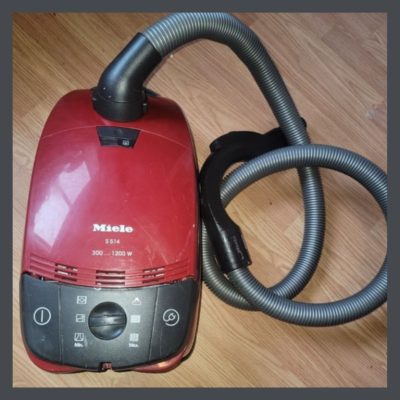
For a more thorough clean, I pull out my trusty canister Miele. It has a HEPA system, not just a HEPA filter. I use a soft brush attachment that I routinely check for any pieces of plastic that could touch the floor. I run this over the floor, using a wee bit of pressure, to ensure that the brush is loosening dirt from the grain. This is my second Miele canister. The first one was ruined by a housekeeper who ran it without a bag.
MOPPING A POLY COATED WOOD FLOOR
The word mopping conjures up visions of dripping string mops & buckets of soapy water. THIS IS NOT THAT!!!!
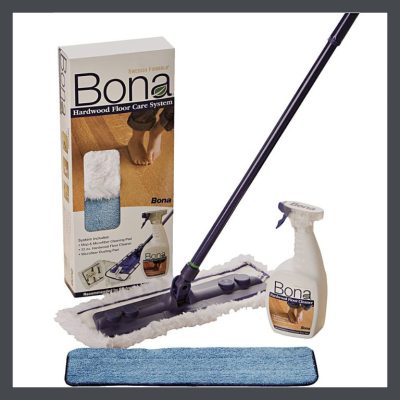
I highly recommend using Bona’s original cleaning formula with its basic mop. Here’s the whole system in a package on Amazon. There are other similar products offered by Bona but I am not a fan of scented cleaning products & their other, fancier mops that squirt, don’t allow me to clean as thoroughly as I would like, while protecting my floor. I also purchase several additional mop heads.
After I Swiffer & vacuum, I spray a section, starting at a far wall, about 6′ X 6′ with a little bit of Bona. I just mist it, really. Then I take my nice, clean dry Bona mop & going with the grain of the wood, I mop up the water. I get that floor dry. As I move from section to section, I check my mop head for dampness & dirt & change it for a fresh, clean, dry one at least every room. The purpose of the mop is to pick up the moisture & the dirt, not lay it down. I stick the mop heads in a plastic back as I go along. I don’t leave them on the floor. They then go in the washer & dryer with my other rags & are ready to go for next time.
Does all this sound too easy? Well, it is. Here are my only cautions:
1. Buy at least 6 extra mop heads.
2. Do not use a great deal of the cleaning fluid in any single area. If you have to spray it & wipe it again, so be it.
3. If you buy a gallon of the concentrated cleaner, do not make the mistake of using it without mixing it with the amount of water in the instructions. Ensure that your housekeeper understands this. I’m recalling now that I actually did get a call from one of our customers. Her floor was cloudy & sticky. Turned out her housekeeper used the fluid full strength instead of mixing it with water 7 to 1. For months! I told her to hide the bottle of concentrate & just rinse it a couple times every cleaning. This worked. She saw improvement with the first rinse.
4. Occasionally mop with just sprayed water. The Bona can leave a tiny amount of film that over time might become noticeable.
5. Keep an eye on your floor for the finish wearing in high traffic area. When you see finish wear, (loss of sheen) call your wood flooring company & ask them if it’s time for a re-coat of your high traffic areas. If you keep your floor coated, barring disaster such as deep scratches or water damage, you’ll never have to refinish it again. We are big on saving wood floors & like advise folks to keep them protected.
I recommend that you read all the articles in the WOOD FLOOR section so that you will have full understanding & appreciation from these gifts from Mother Nature.
STAY IN THE BUNGALOW KNOW!!!
Sign up for our newsletter & receive our FREE E-book, 7 VITAL Things to Do Before You Hire a Contractor.
In this internet age, there is very little that you can’t find on YouTube so I have put together a list of old house restoration videos, arranged by skill/trade/interest for you to view. Whether you plan to do a project yourself, or hire a professional tradesperson, it is wise to know about bungalow, their history, their features. It’s also a good way to educate the people that you hire who might be looking to improve their knowledge & would be willing to watch these old house restoration videos to expand their skills.
The people who have made these videos are at the tops of their fields. They are experienced & skilled not only in their areas but also are good communicators & have stellar reputations for their abilities to teach others. They are also very nice people so their videos are pleasant & easy to watch. In fact, I watch them when I’ve had a bad day just to chill!
I’m not going to describe the videos individually because most of the titles explain the content. Just click & find out!
ARCHITECTURAL SALVAGE VIDEOS
The terrible tragedy is that old buildings will be demolished, by the short-sighted, by the greedy & the ignorant. We are fortunate that there are people who come in & save the beautiful bits & pieces & offer them to us. Even if you are not involved in a project for which you might need their wares, a visit makes an interesting field, or even a road trip!
Architectural Salvage tour- TREASURE HUNT! Finding clues from the past. (10:20)
Brent Hull
Southern Accents and the Journey of Architectural Salvage (2:48)
This is Alabama
BUT WAIT, THERE’S MORE!
I have curated a wonderful playlist of helpful & entertaining videos for your viewing pleasure. Bring out the popcorn & learn about everything from wood window repair to the history of the bungalow to how to take care of yourself when you dealing with the physical & mental challenges of restoring an old house.
Also you can check out my article on architectural salvage which links to some great resources.
STAY IN THE BUNGALOW KNOW!!!
Sign up for our newsletter & receive our FREE E-book, 7 VITAL Things to Do Before You Hire a Contractor.
I put a call out to my Facebook followers for their favorite bungalow architectural salvage resources. I have long been a fan of the idea of salvage, as well the the practicalities of the practice. In my previous article, I write about the cultural, economic & ecological benefits of salvage & in this article, I write about the ones that they recommend & ones at which I have shopped over the years.
I tend to get a bit mesmerized in a salvage shop. While you see a plethora of objects, of all ages & types, the story is incomplete. Riveted by these bits of story. I get unpopular pretty fast because I ask so many questions but I’m a woman who loves a story, mine or someone else’s, & I feel untethered when I don’t know the details.
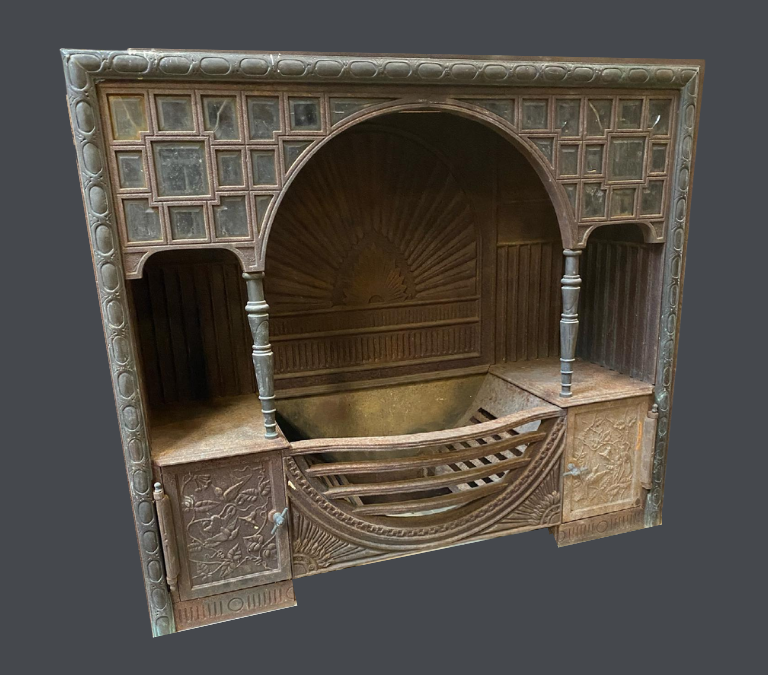
Occasionally, it is difficult is even understand an object’s purpose! The object to the left, provided by Doc’s Architectural Salvation, is clearly a product of The Aesthetic Movement, an art movement in the late 1800’s which valued the beauty of the the applied & fine arts over any social ramifications. You have heard the expression, “art for art’s sake?” This philosophy was manifested in the work of the Aesthetic Movement.
(I’m rather partial to this design style myself, & my dishware at my home in Eagle Rock, the Hare House, was of an Aesthetic pattern. I displayed it on my plate rail in my dining room & heck if it didn’t look wonderful with my Craftsman built-ins & my Restoration Hardware, Stickley knock-off dining table.) But more importantly, what is this thing?
Now you know how I feel in a salvage store!
BUNGALOW ARCHITECTURAL SALVAGE RESOURCES ALL OVER THE COUNTRY
I’m going to split up the country into sections. As I hear from you (hint, hint-see the comment form below?) I will break it up by state. So let’s get salvage shopping!
Established in 1999, Aurora Mills is a multi-facted store offering antique & vintage architectural items, lighting, reclaimed lumber, iron gates, doors, fireplace mantles- pretty the much the full array. They have an extensive website with a large online inventory as well as a tour of the warehouse which I opened on my big screen. Wow!!!
For the bungalow crowd, they carry Arts & Crafts tiles & other Craftsman pieces.
My Instagram pal, hosshouse1879 tells me, “They do an excellent job of organizing the materials that they have salvaged. If you go in looking for a house part, they know what area to go to & make the search pretty easy.”
Norm, the proprietor has a great affinity for Arts & Crafts & is always on the look-out for items appropriate to the bungalow. He has a good stock of lighting, doors & hardware for us & often has some furniture & even colonade sets that would we would love.
Rebuilders Xchange
“We partner with communities to transform the home building and design industry into a circular economy.”
Cleveland, Ohio
Referrer Amy K. says, ”It’s a fantastic place to just wander & look at all the treasures they’ve saved.”
So, I wandered through their website & found many items in their 50,000 sq. ft. jam-packed warehouse, in various categories that would be appropriate for bungalows, such as doors, windows, flooring, hardware, cabinets & cabinet doors, lighting, mantels, even kitchen sinks with drainboards (they come & go.)
In speaking with them I discovered that all items are on consignment, which encourages homeowners to recycle instead of contributing to the landfill. They even have several elderly pickers who bring things in to them to supplement their incomes.
Construction Junction is a non-profit organization which sells its donations of used & surplus materials in its 30,000 square foot store.
Sue D., a FB follower posted, “Construction Junction is wonderful! We needed a new door for our 1920 bungalow & found a perfect match for $5.00. And they wanted to give us a second one for free!’
They are always accepting donations & look forward to your visit.
Doc & his crew travel all over the U.S. carefully taking apart old structures. As terrible as it is that these buildings are demolished, they are there to make sure that much is saved.
In their 30,00 sq. ft. ware house they have an abundant supply of lighting, bathroom fixtures & hardware, mantels, doors & windows & more.
All the images from this page & the one about the wonders of salvage are from Doc’s.
First of all, when you are on their site, you have to hit the OUR STORY link. The tale of this family business will both touch & amuse you. Dad started it out of love for salvage & over the decades, the business & the family just grew!
Martha L., my follower on Facebook says, “They have a huge selection & it is very organized. Their inventory is updated continually. Prices are reasonable.”
Speaking of huge selection, when you click the INVENTORY link, a full page menu drops down & each category displays another page plus.
Over 20 years ago, when I was restoring my 1910 Craftsman, the Hare House, I frequently visited Architectural Details in Pasadena, home of the Gamble House, the Blacker House, Bungalow Heaven & an glorious abundance of historic homes & commercial buildings. I was astounded that the huge space could not only be so full of old salvage, but so tidy & organized. The inventory was meticulously kept in an index of 3’X5″ note cards & there was nothing that was untracked or out of place.We drooled over the Batchelder tiles kept behind the counter wishing our fireplace was in need of mending.
A quarter of a century later, after the owner’s retirement, Architectural Details has morphed into Pasadena Architectural Salvage with just as many wonderful, orderly items (tracked electronically, I’m sure!). The folks here are very friendly & I’m sorry I’m so far away! However, looking at their website is quite the treat & even includes a couple Batchelder fireplace surrounds.
MORE! I WANT MORE!
I know that there are other great salvage outlets scattered about the U.S. & I want to know about them & why they are special. So plunk your magic twanger, Froggies & zip on down to the COMMENT section. Become visible. (For those of you who have no idea what I’m talking about, click here to see a link for a very strange children’s show in the 50’s. I shudder to think what the exposure of this to my 5 year old self had on my development.)
STAY IN THE BUNGALOW KNOW!!!
Sign up for our newsletter & receive our FREE E-book, 7 VITAL Things to Do Before You Hire a Contractor.
If you should be fortunate enough to have a bungalow, architectural salvage can be your BFF. Merriam Webster defines salvage as “property saved from destruction in a calamity (such as a wreck or fire).”
Cambridge adds, “to try to make a bad situation better.”
Not surprisingly, the derivation is from the French, “to save.”
Personally, I consider the destruction of a historic building, by Mother Nature, Father Time, or the hand of Man to be a crushing calamity & I have spent my adult life trying to get people to understand their value. Read my story here.
There are so many arguments against annihilating our built heritage financially, culturally & aesthetically that it both puzzles & pains me that our it is destroyed so casually. Whether by neglect, natural disaster or ignorance & short-sighted greed, the stories of our communities are lost forever, turned to rubble & to dust.
Making lemonade, making “a bad situation better,” out of this sour mess, are those who are involved in architectural salvation. Architectural salvage involves carefully removing materials from a historic (or even a newer) structure that is going to be remuddled or completely destroyed. Instead of ruining these materials, & sending them to the landfill, salvagers give them a new life. Here’s a page of them, recommended by my Facebook followers outlets all over the U.S.
ARCHITECTURAL SALVAGE IS GREEN
The footprint of architectural salvage materials is generally only that of transportation, from the original site, to the warehouse, to its final resting place, your bungalow. Keeping tons of stuff out of the landfills is almost beneficial.
My buddy, Doc, of Doc’s Architectural Salvage and Reclamation Service, outside of Nashville, who provided me with all these gorgeous images, is a master of the art. His well-ordered, abundantly stocked shop, Architectural Salvation is 38,000 sq. ft. of fine salvaged materials from homes, churches & commercial buildings & even ships. He & his crew have meticulously extracted these items from doomed structures, hauled them to his shop, cleaned & repaired them & offer them for sale to those who understand & appreciate their value.
I’m not going to try to ‘splain about Doc or Doc’s Architectural Salvation to you here when his website & social media do a good job of it. However, in the interest of full disclosure, Doc allows me to use his images for my blog & social media & buys me tacos when I visit him for the mention. I love tacos.
ANOTHER BONUS OF SHOPPING FOR ARCHITECTURAL SALVAGE
The people who run these places have huge amounts of knowledge that they are willing and eager to impart to you for free. They are experts & aficionados of historic architecture & design. They have seen these old items in their original settings. They can date them. Often, they have repaired them so they know a great deal about the materials & construction of each one. Just visit for a lesson. You will be warmly welcomed. (Yes, there are a few curmudgeons in the mix, but the worst one is now retired!)
Please visit the BUNGALOW ARCHITECTURAL SALVAGE RESOURCES page to see outlets from all over the U.S. that were recommended by my Facebook followers. I encourage you to add the ones that you like the best too. Just scroll on down to the comments section.
STAY IN THE BUNGALOW KNOW!!!
Sign up for our newsletter & receive our FREE E-book, 7 VITAL Things to Do Before You Hire a Contractor.
Once upon a time, I was standing in line at a Japanese take-out (great place!) & stepped back when I noticed the grungy guy in front of me. He was wearing a t-shirt that had seen 1,000 better days. It was a bit hiked up in the back, & I could almost see his heinie protruding from his well-worn, baggy jeans. His hair, was long & tied back in a raggedy ponytail.
Imagine my surprise when, after ordering, he turned around to display the twinkliest blue eyes I have ever seen (Yes, that includes Santa.) & the biggest most beautiful smile. He grabbed my husband in a big hug & they both bounced up & down exclaiming their extreme joy at seeing one another.
Turns out that this raggedy guy, who upon further inspection was spotlessly clean & fresh, was an old house contractor for whom my husband often worked. Garrett enjoyed a stellar reputation in Los Angeles & with our company because he consistently delivered beautiful work, & ran his business- scheduling, communication, legal, etc. – meticulously & heartfully. After this fortuitous introduction, he performed a great deal of work for me at the Hare House & I was always happy to see him & glad to pay him. Upon further acquaintance, I learned that he conducted his entire life in this fashion, being an extraordinary husband & a loving, enthusiastic father. I only wish every contractor I met had been even similar to this wonderful man. He was just not a fashion plate!
HIRE THE OLD HOUSE CONTRACTOR WITH THE NICEST SHIRT
Maybe not. I wrote the E-book, 7 VITAL Things to Do Before You Hire a Contractor, after reading terrible & sad stories on the Facebook, old house, group blogs. In every single story I could see the exact moment at which the project fell apart, the money got ripped off, the house got ruined, the heart got broken. Looking at my own heartbreaks, I could see the same pesky factors at play.
After 45 years as a specialty contractor (wood floors) & old house restorer (5- here’s the most awful one!) I have seen my share of horrifying surprises, so I decided to write a little book in hopes of making someone else’s path a wee bit smoother.
I established my company based on the firm policy of always exceeding the customer’s wishes & any time I failed to do this, examined every step of the process to find out how I could make it better next time. It’s always easy to cast blame on the other guy, & with any failed job, there is always plenty of blame to go around. However, there was always some piece of it that I had to call my own whether or not it made me highly uncomfortable to do so. And it did.
So I took my experiences on both side of the contract to see if I could create some advice that would be useful to a homeowner when they leap off the cliff & hire an old house contractor. I’m a big believer in jumping off that cliff & building my wings on the way down, but it helps to at least have a bag of feathers & maybe some chicken wire before giving it all up to gravity.
This article is just to show you the myriad ways you can land in the abyss that it are important to know, especially if you are venturing into restoration for the first time. To get the whole book, I’d love for you to sign up for my mailing list, but mostly, I just want to make sure that you don’t get Bozo’d like I did! So, if you don’t to be on the mailing list, just let me know & I’ll send you the book & disengage you. (But just so’s you know, I send some fun stuff!)
HOW TO HIRE AN OLD HOUSE CONTRACTOR- STEP BY STEP
INTRODUCTION
You have purchased a 100 year old (give or take) bungalow. You have your home inspection in your hand & you want to move forward on your restoration. You are not a DIY’er & do not plan to be one. You have a demanding job, perhaps a family & other responsibilities. You’ll need to hire an old house contractor or contractors, & you’ll be depending on the kindness of strangers to turn your house into a home. So, how do you find the best strangers?
I wrote training manuals for 40 years so I am big on proper sequencing & I loves me a checklist. So here are my suggested steps.
Find out:
What is a bungalow? What are best restoration practices?
What are your own needs?
How do I find good tradespeople in my area?
What else do I need to know about these folks?
A. Referrals
B. Reviews
C. Go legal.
It’s only at this point that you start talking to people.
How do you conduct the first interview? What should you ask? What should you request?
The Proposal- what should it include?
How do I make sure that the restoration is satisfactory?
I go through each one of these steps in detail, in fact, each step is a section with sub-sections! I like to break it up to make it easy to understand & doable. I talk about your goals, your expectations, your money, & the joys of living life on a jobsite. I spend a great deal of time addressing the contract because that’s the basis of all that will transpire.
(That having been said, I am not a lawyer. Neither this article not my little booklet, should be construed as being legal advice. It is friendly direction- my tale of what has & what has not been effective for me. While I’m at it, I will mention that I have done all the steps I suggest & still gotten a crappy project. ‘Tis the human condition but, when I haven’t done it, I have gotten a crappy project 100% of the time!
I have no training beyond what I got in a ballet studio, no credentials, no licenses, no nothin’ in the construction trades nor in law. I have only my experience from which I draw & I can boast of having lost over $50,000 on a single project because the contractor I hired should have been in jail & ended up there soon after I fired him!)
STAY IN THE BUNGALOW KNOW!!!
Sign up for our newsletter & receive the complete FREE E-book, 7 VITAL Things to Do Before You Hire a Contractor.
By attending old house classes, a conscientious steward can learn the basics of old house repair & maintenance. Owning an old house is not for sissies, nor for the uninformed. When I owned The Hare House, my 1910 Craftsman in Eagle Rock, I made some mistakes that I would have not made, & tossed away money that I would still have in my pocket, had I access to any of the education offered below.
Even if you are not a hands-on restorer, by inclination, aptitude (or the lack of) or physical condition, you need to have some knowledge of these skills.You can also use them to educate any trusted tradesman that you have working at your home to expand their skills. This can save you money & provide you with services to which you might not have access in your area.
I suggest contacting the event producer about any classes that appeals to you that might require physicality beyond your own capabilities, to see if they can accommodate you. They want you to learn so they will make it as easy as they can for you.
The best thing about attending is that it gives you the opportunity to meet like-minded folks. I have met wonderful people in my preservation activities & formed many strong friendships. I urge you to participate. It will enrich your life!
I AM FULLY AWARE THAT MY LIST IS WOEFULLY INCOMPLETE! Please let me know what I have missed so that I can add them.
Hands-on workshops are taught by professionals who are looking toward building the resources necessary preserving the future of the trades.
Participants learn a variety of crafts in order to pursue & succeed in vocations in the preservation trades. The Center’s goal is to build the next generation of highly trained artisans.
They offer classes in:
Historic Preservation Boot Camp is a 3-day workshop covering repointing, plastering, & brick/stone repairs
Repointing Brick & Stone Using Lime Mortar
Repointing Special Joint Profiles Using Lime Mortar
The Association offers an extensive menu of seminars, webinars & hands-on workshops, designed to help you preserve & improve the appearance, usability & value of your home.
Though they focus on bungalow, they offer help to anyone who owns an old house of any style or age. They are some of the friendliest people in preservation that I have ever met. I have called them several times with questions regarding bungalow characteristics in the Midwest & they have always gone out of their way to obtain the information requested & relay it to me.
Take advantage of their many educational videos on many subjects, all beautifully & clearly presented.
Sign up for their email list so you can stay informed whether or not you live in Chicago! If you do live there, you’re welcome.
Bob Yapp, after traveling the country, teaching preservation skills, had the dream of establishing a hands-on trade school, delivering workshops to students of all ages, lasting from 2 day to 8 days. His students come from all parts of the world to learn from this master.
The Beleveder School is lodged in the historic brick, antebellum, 1859 Italianate, Alfred Lamb Mansion which also holds his wife’s bed & breakfast. Known for its delicious breakfasts, the B&B provides a wonderful setting for making lifelong friends.
He also delivers seminars & workshops on many different topics to communities all over the U.S.
Founded in 2022, Preservation Corps United offers expert education in historic preservation & restoration to homeowners & construction professionals.
The founder, Tanya Keith, offers some impressive credential& & imparts this knowledge to those who attend her school.
Education:
2.5 years of Industrial Design program at Carnegie Mellon University, BFA Interior Design from Iowa State University with minors in Craft Design: Woodworking and Sociology
NCIDQ Certified Interior Designer since 2001
Belvedere School for Hands on Preservation Certificates:
Passive Wood Floor Restoration, Building Wooden Storm Windows, Restoration of Historic Stained Glass, Historic Plaster Repair, Historic Masonry Repair
Certified in Window Restoration by David Wadsworth.
“Whether you’re an individual or part of a group or business, if you believe in a future that honors our old buildings, beautiful towns, and our culture, you are a part of Rethos.”
Rethos is a non-profit organization offering hands-on & Zoom classes as well as informative videos to homeowners in all aspects of preservation. They are perfectly amenable to your attending a workshop without physically participating. You can learn a great deal by just watching! They offer classes such as:
Lead, Asbestos & Radon
Old Home Certified for Realtors®, a regional designation
Window Restoration
Drafting a Maintenance Plan
Wallpaper Installation
DIY Plumbing
PROFESSIONAL (OR WANNA-BE PRO) WOOD WINDOW RESTORATION EDUCATION
This group, composed of the most knowledgeable people in the field from all over the country, is a trade organization dedicated to saving old wood windows. In addition to connecting pro’s with homeowners, they assist everyone from those who want to have careers in wood window restoration, to established pro’s.
The WPA provide resources & information on products & materials as well as general information on running a successful business. They also “help preservationists find the tools they need to educate building owners, architects, and other decision makers about the value of original windows.”
If you wish to host a old house classes, contact them to see if they could provide you with a speaker/demonstrator. If you, or someone you know would like to spend your life returning old houses to their former glory, they are standing by to give you the education & assistance you need to be a successful professional.
PRODUCE OLD HOUSE CLASSES IN YOUR AREA
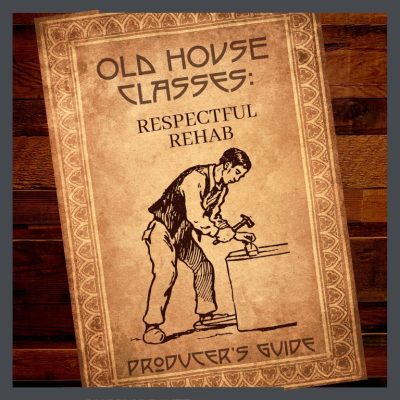
I am working on a manual (It’s pretty close to being done.) for hosting such an event, laying out step-by-step what to do to choose topics, attract craftsmen & volunteers, promote it & make some $$$ for your organization, & run a smooth-running day of hands-on, old house learning.
The manual is divided into sections, & I have included a timeline that cross references the sections so that you can go step-by-step through locating a venue, attracting speakers & demonstrators, recruiting enthusiastic volunteers & promoting the event to the public.
Let me know if you or your organization is interested in learning how to host classes & I’ll get working on this thing a bit faster! I’m going to sell it for a whole $25.00 because if you pay for it, you’re more likely to use it.
LOCAL HISTORIC PRESERVATION ADVOCACY GROUPS’ CLASSES
Many preservation groups host classes so if you are interested in attending, contact your local group. I am building lists of such groups, but it’s taking a ridiculously long time to create such a list for all 50 states so if you don’t see it here, Google “historic preservation your city.”
If you are involved in a preservation group, please encourage them to host old house classes. It’s a good P.R. activity, will encourage membership & it also can raise some serious funds.
THE BENEFITS OF OLD HOUSE CLASSES
Even if you have no plans to live the DIY life, it is important to understand how your house works. If any of these topics interest you, but you don’t have the physical capabilities perform the work, most of them will allow you to participate as an observer.
These are also great learning sources for the tradespeople who work for you. You need to have someone you can count on who has these skills & it may be up to you to ensure that they get them.
There are young people all over the United States who would love to be trained in these trades & make this work their vocation. You can do your bit for preservation by letting them know about these opportunities. I have a book in my hip pocket that is about 50% complete, about how to run a successful specialty contracting business. My plan is to complete the dang thing & somehow raise the money needed to have it printed & then donate the books to high schools. So, someday I may be coming to you, asking for a hand-out & for your assistance in placing them!
STAY IN THE BUNGALOW KNOW!!!
Sign up for our newsletter & receive our FREE E-book, 7 VITAL Things to Do Before You Hire a Contractor.


 This guide of how to clean & maintain your wood floors applies only to floors with a surface coating type of finish such as oil-based polyurethane finish, water based finishes, etc. For floors with penetrating finish, refer to your manufacturer’s instructions.
 Let’s start with our canine buddies.
 Here’s where you’re going to get instructions that are unique to me. I have seen many, many floors ruined by loving hands.I have spoken to many heart-broken homeowners whose new floors were cupping (Here’s the GLOSSARY!) or cloudy. They all had one thing in common. They weren’t my customers! My customers got a cute little care basket with a cleaning kit, feet & most importantly, instructions on how to use them, at the end of the job.
 The word mopping conjures up visions of dripping string mops & buckets of soapy water. THIS IS NOT THAT!!!!
 STAY IN THE BUNGALOW KNOW!!!
 In this internet age, there is very little that you can’t find on YouTube so I have put together a list of old house restoration videos, arranged by skill/trade/interest for you to view. Whether you plan to do a project yourself, or hire a professional tradesperson, it is wise to know about bungalow, their history, their features. It’s also a good way to educate the people that you hire who might be looking to improve their knowledge & would be willing to watch these old house restoration videos to expand their skills.
 I put a call out to my Facebook followers for their favorite bungalow architectural salvage resources. I have long been a fan of the idea of salvage, as well the the practicalities of the practice. In my

 Rebuilders Xchange
 Construction Junction

 Southern Accents
  Pasadena Architectural Salvage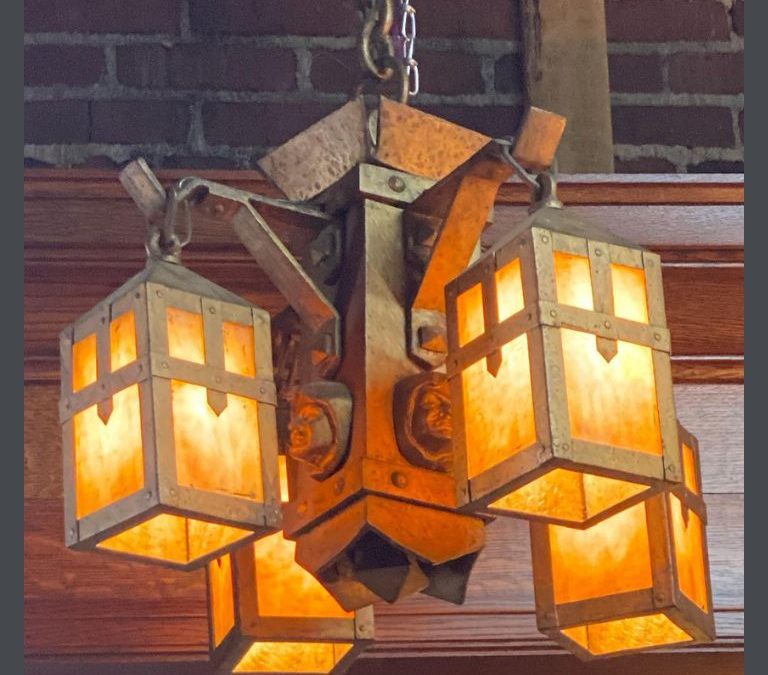
 If you should be fortunate enough to have a bungalow, architectural salvage can be your BFF. Merriam Webster defines salvage as “property saved from destruction in a calamity (such as a wreck or fire).”
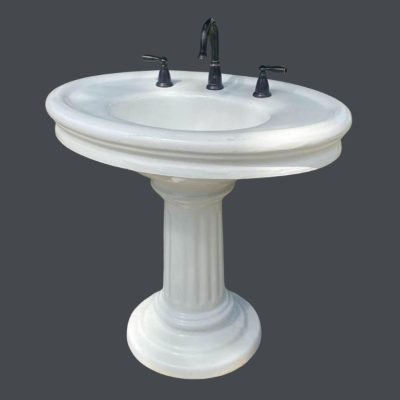 The footprint of architectural salvage materials is generally only that of transportation, from the original site, to the warehouse, to its final resting place, your bungalow. Keeping tons of stuff out of the landfills is almost beneficial.
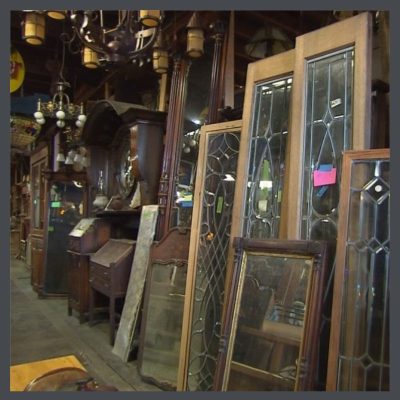 The people who run these places have huge amounts of knowledge that they are willing and eager to impart to you for free. They are experts & aficionados of historic architecture & design. They have seen these old items in their original settings. They can date them. Often, they have repaired them so they know a great deal about the materials & construction of each one. Just visit for a lesson. You will be warmly welcomed. (Yes, there are a few curmudgeons in the mix, but the worst one is now retired!)
 Once upon a time, I was standing in line at a Japanese take-out (great place!) & stepped back when I noticed the grungy guy in front of me. He was wearing a t-shirt that had seen 1,000 better days. It was a bit hiked up in the back, & I could almost see his heinie protruding from his well-worn, baggy jeans. His hair, was long & tied back in a raggedy ponytail.
 INTRODUCTION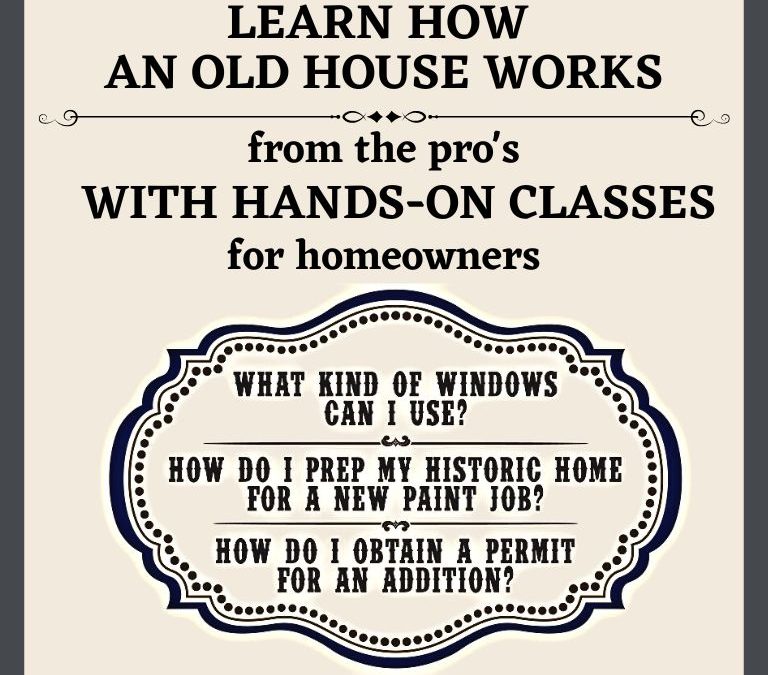
 By attending old house classes, a conscientious steward can learn the basics of old house repair & maintenance. Owning an old house is not for sissies, nor for the uninformed. When I owned
 Chicago Bungalow Association
 Belvedere School for Hands-On Preservation

 I am working on a manual (It’s pretty close to being done.) for hosting such an event, laying out step-by-step what to do to choose topics, attract craftsmen & volunteers, promote it & make some $$$ for your organization, & run a smooth-running day of hands-on, old house learning.
 There are young people all over the United States who would love to be trained in these trades & make this work their vocation. You can do your bit for preservation by letting them know about these opportunities. I have a book in my hip pocket that is about 50% complete, about how to run a successful specialty contracting business. My plan is to complete the dang thing & somehow raise the money needed to have it printed & then donate the books to high schools. So, someday I may be coming to you, asking for a hand-out & for your assistance in placing them!