by bungalow101 | May 17, 2022 | Life & times
by Barbara Farrar (October 6, 1926 – March 29, 2011)
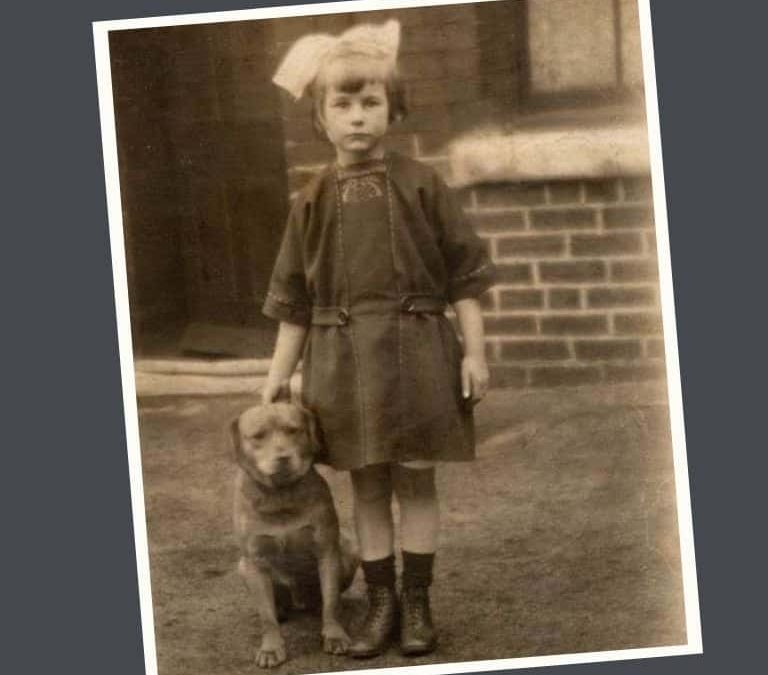
 As I recall the years of my childhood spent in “Tampa Town,” I am always cognizant of the changes that have accompanied our metamorphosis into a much larger city. One of them has impacted the daily lives of today’s neighborhood children. It has to do with pets and the different role they presently play. In those days, we all had pets, but they were not like the pampered, purebred or exotic ones prized by children today. They were “adopted” stray dogs and cats (Heinz 57 variety), plus many other varied forms of wildlife….and I do mean wild.
You see, Seminole Heights was not thickly populated, and was surrounded by acres of undeveloped woods. The Hillsborough River was a source of water and habitat for the native animals which frequented our bungalow neighborhood, and to which we children were hypnotically drawn. Likewise, they seemed to trust us, and we openly, or surreptitiously, fed them. Occasionally, these wild visitors were injured or just seemed sickly, so we established a “hospital” where we took turns caring for them. This was usually in one of our garages. Baby birds, squirrels, bunnies, possum and raccoons were frequent patients. We also cared for field mice, injured water birds, bats and songbirds. We raided our families’ medicine chests for various ointments, antiseptics and bandages. Produce boxes that came with ventilation holes made great cages. Chicken feed, cat and dog food and milk were the usual infirmary diet that kept them alive. However, I must admit that the survival rate was not very high. But, you can be assured that each deceased patient was given a full funeral from casket burial to flowers and a headstone in a nearby “pet cemetery”.
Pet care was, totally, the child’s responsibility. Any failure to assume this responsibility resulted in strict discipline and/or removal of the pet. Responsibility was developed at an early age.
No pets, domestic or wild, were ever allowed in the house or the car. Canaries, parrots and goldfish were the only indoor pets. Bad storms and freezing weather were the only exceptions to the house rule. Dogs and cats were fed canned pet food and table scraps. They were allowed to eat in the kitchen before being sent outside. Fresh drinking water was always available both inside and out. Dog and cat diets were supplemented by our trips to the local butcher shop. The owner, who was a neighbor, saved meat scraps and bones for the dogs and beef liver pieces for the cats.
 Oddly enough, our cats and dogs were rarely ill. There were very few vets in the area, except for those who treated livestock. Once a year, our dogs got a rabies shot and tags to wear as well as an “annual worming.” The dogcatcher was quick to impound a tagless dog. There was no need to “walk the dog”. Wherever we children went, our four-footed friends trotted with us. We played so closely with them, that they seemed almost like siblings. They really enjoyed pacing us on our bicycles, the faster the better. Playing “hide and seek” was a favorite activity which they always won. The real challenge came during baseball games when the outfielder often had to out run the dogs for the ball. In retrospect, our dogs were tolerant and long-suffering. They endured many bumpy rides in our wagons, while dressed in some pretty weird outfits that only a child could create.
A special neighborhood pet was the green chameleon. We all had one which we confined with a collar of silk thread and wore on our shoulders. What we didn’t understand at the time was why it occasionally inflated that bright, red bubble under its throat. Eventually, we learned it was done to frighten enemies. The poor thing was terrified! We just thought it was pretty!
Today, I see only adult dog walkers pass my home. The majority wear headsets, and show impatience with the animal’s frequent “scent stops”. I often think of the sheer joy and wild abandon that neighborhood children shared in play with their pets. Tampa Town was truly a kinder, gentler place in which to experience reciprocal affection with one’s pet. Its disappearance is a tremendous loss.
ABOUT BARBARA
 I had the great honor & extreme pleasure, of meeting Barbara when I interviewed her for the documentary film, Seminole Heights, An Intimate Look at the Early Years, that I produced about the neighborhood. In her 80’s, she was warm, bright, perceptive, articulate, & possessed a whimsical sense of humor. I have to say that she was the star of the show.
Barbara had spent her whole life in the Seminole Heights, attended our neighborhood schools graduating from Hillsborough High School in 1946, & in 1990, she was inducted into their Hall of Fame.
Barbara graduated in the first class of the newly established Florida State University in 1948 with a degree in journalism, & continued her education to get a Master’s Degree in Social Work. She went on to work for 41 years as a social worker.
In addition to being the champion for hundreds of children & families, Barbara worked as a volunteer for many organizations, focusing on our neighborhood. Serving as Editor of the Old Seminole Heights Neighborhood Association newsletter, The Advisor, Barbara strove to build a sense of community & respect for our history. She is warmly remembered & sadly missed.
 STAY IN THE BUNGALOW KNOW!!!
Sign up for our newsletter & receive our FREE E-book, 7 VITAL Things to Do Before You Hire a Contractor.
by bungalow101 | May 16, 2022 | The arts & the crafts, The History
by Janet Lea Haddock CID #4333
Instructional Specialist of Interior Design
Anne Arundel Community College
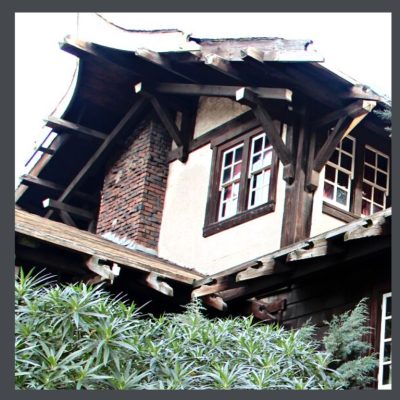 These two words are tossed around today by Realtors, consumers, builders & designers. We say them… “I love arts and crafts furniture”, we ask for them… “I want to buy an Arts & Crafts bungalow”, but are those two words understood? Do those requests come from a place of knowledge or from a think tank somewhere deciding that Arts & Crafts i.e., Craftsman was going to be a new historic-based trend to sell merchandise and home design. Is the term “Arts & Crafts” a style, a movement, or something else?
To be a loyalist to this movement when browsing the aisles of big box stores can be challenging. The undisciplined explosion of furnishings for the home was born from the industrial revolution. It brought garish results with a lack of proportion & overly embellished decorative details. Mass production was now possible so furniture, carpet & drapery, formerly only affordable to the wealthy, was now within reach of the common man.
THE ARTS & CRAFTS MOVEMENT THAT BIRTHED THE BUNGALOW
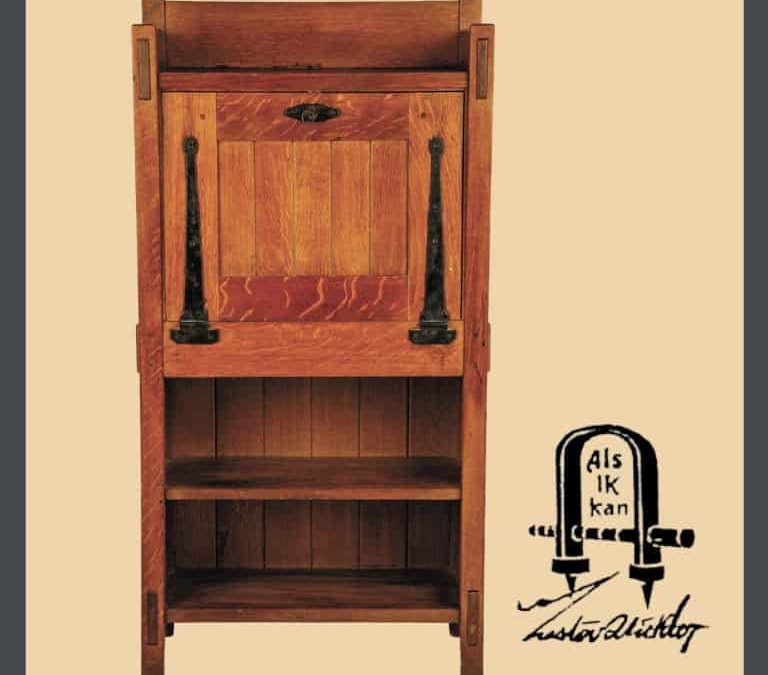
 Today we celebrate those individuals who said, “no thank you” & gave birth to the Arts & Crafts movement. It was really a restoration, a return to “master craftsmanship” in furniture construction which led to home construction & design. It was a rejection to theatrical excessiveness. The mission was “truth to materials.” It embraced exposed joinery, natural finishes, simple lines while combining materials like metal & wood. Appreciating the beauty of those materials in a far simpler format that could be affordable to the masses was the intent. The term “mission furniture” is about the mission of truth to materials, but often mistaken for furnishings used in religious facilities known as missions, especially prevalent in California. Now how does this tie into “the Bungalow”?
AMERICAN BUNGALOW STYLE (1905-1930)
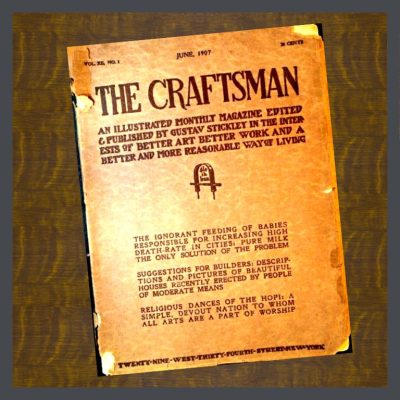 Characteristics. Simple design, sparse decoration, and natural materials—these were the essential components of the Bungalow style.
Materials. The materials used for the bungalow’s exterior usually suggested warmth & informality. …
That description is taken directly from the Wentworth Studio, a firm of architects and builders, specializing in restoring historic properties.
The concept of bungalows started with structures that were created in India for a British officer’s home (1890). They were not necessarily small houses in the beginning (circa. 1890), but grew (or shrank) to be a one-story home, typically a smaller square footage with deep overhangs. The late 1800s & the turn of the century, having no significant HVAC & limited use of electricity, used the overhangs in the roofing as a means of interior comfort management for seasonal weather. Meanwhile Sears Roebuck & Co. had begun to send catalogs directly to consumers. Home plans for bungalows appeared in 1908 for the first time…
RENOVATING YOUR BUNGALOW- CHOOSE AUTHENTIC ARTS & CRAFTS FINISHES
So what are we learning from this information? When renovating a bungalow…seek out authentic sources for the finish details like hardware, tile, light fixtures, etc. Truth to materials means to appreciate & use the materials as they were meant to be seen. Walls were painted, woodwork was stained. Brick was chosen for its color, not colorized once in place. The deep overhangs limited sunlight from entering the rooms so warm colors were painted on the walls. Wood darkens over time as it ages. When we see an Arts & Crafts bungalow today, perhaps the dark wood originally wasn’t as dark…light colored simple drapery hung at the windows. Built-ins provided an efficient use of space with glass doors, often leaded glass, giving both storage & beauty.
Gustav Stickley is celebrated & attached to this movement & justifiably so, but he isn’t the only Craftsman tied into the Arts & Crafts movement. History includes the Aesthetic movement within it bringing William Morris, Charles Rennie Mackintosh, Greene & Greene architects & early Frank Lloyd Wright in the credits. Art Nouveau, French based was happening simultaneously & its influence is apparent in many bungalows. All bungalows are not of a singular style because of those influences. They also embraced Victorian & Spanish influences, especially in the West & Southwest where weather conditions were friendly to stucco exteriors & large expanses of glass. The common threads are the physical size, predominantly single-story living, front porches where people enjoyed socializing with passersby & the charm they exhude. Dining rooms were large, living rooms & bedrooms…not so large. Closets…well, let’s not go there.
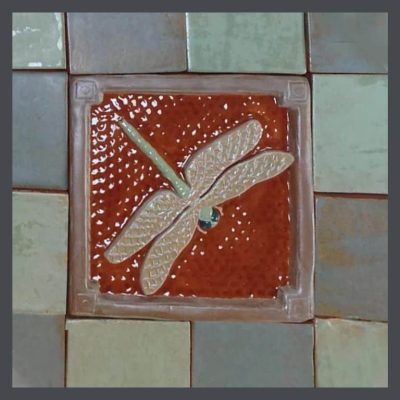 As we walk down the aisles of Home Depot, Lowes or Menards…wherever your shopping options are as you repair & improve your bungalow, a person can find stock tile that can be laid in patterns to complement that era. Perhaps a splurge of 3-5 pieces of vintage tile to complete an authentic visual could be in the budget. Linoleum, which you can read about here, is authentic to this era & is considered one of the earliest sustainable material finishes for flooring. Choose your pattern carefully.
Resist the urge to paint the woodwork, but should it be your only option (or sometimes the best option) study the charts in your local paint supplier & read my articles about era appropriate colors. Patience in making the right choice is a virtue & celebrated by your fellow Arts & Crafts lovers. Avoid synthetic materials. They did not exist during this time. One can still have modern convenience without man made finishes. Insert your personal style through your accessories & art as furnishings are easily removable & do not compromise the space.
The bungalow was a great option for the young family in its day. It provided all the basic necessities a growing family needed in an atmosphere of charm & quality craftsmanship. As technology soars at the speed of light, maybe this is our way of pulling back & slowing down a bit…we want to sit on our porches & talk to our neighbors again…for some, it may be their first time.
TIP: FOR SOME GREAT A&C RESOURCES, VISIT OUR PAGE ON ARCHITECTURAL SALVAGE HERE.
STAY IN THE BUNGALOW KNOW!!!
Sign up for our newsletter & receive our FREE E-book, 7 VITAL Things to Do Before You Hire a Contractor.
by bungalow101 | May 11, 2022 | Random Musings
Into every life walks a handful of people who impact your life profoundly. Jane Powell, bungalow author, restorer & advocate, was one of them for me.
 In the winter of 1998, I walked out of my 1966 MCM house in Pasadena where I had lived as a renter for 8 years & gasped to see a FOR SALE sign in the yard. My landlord, who was a darling fellow, had purchased the house shortly before the housing crash in1990, & after having it on the market for some time, decided to put it up for rent. We had moved from Arizona where housing prices were about 1/3 of what they were in L.A. & we decided that renting was our best choice. We were very happy there & eventually would have probably purchased it but for the fact that it was 3 stories hanging off a cliff and my knees were starting to object. And the earthquakes were pretty pretty wild suspended 100 feet up. But hey, my husband always assured me, our house was on bedrock!
Faced with having to move, I kinda panicked. I am not known for being easy to please. I am known for my ability to kick 100 houses to the curb & here we were with an unknown deadline. The L.A. market was heating up, the house was stunning, the area, amazing & I was trying to run a contracting business, set up a lender & find a house that I desperately wanted, totally uncertain as to how long I had before my bags were packed & on the street.
THE SEARCH FOR THE PERFECT HISTORIC HOUSE
 I looked at my 100+ houses. At that time, you didn’t have the option of cruising through images online. Your Realtor printed a list of options for you & you drove & drove & drove. The main area in which I was looking, Eagle Rock was hilly & the streets very windy so it was challenging to find the houses, aided only by my trusty Thomas Guide. (Life is way easier now!)
Eagle Rock is a bungalow community in N.E. Los Angeles. Later I learned its history & its culture, but at that point, I was just looking for a house, a horrible undertaking given the amount of destroyed historic fabric I encountered. I mourned the loss of these features & every day I would come home & cry, & end up with a tummy ache. I realized that I was going to have to DO SOMETHING ABOUT IT, but at this point,I was clueless as to what this might be.
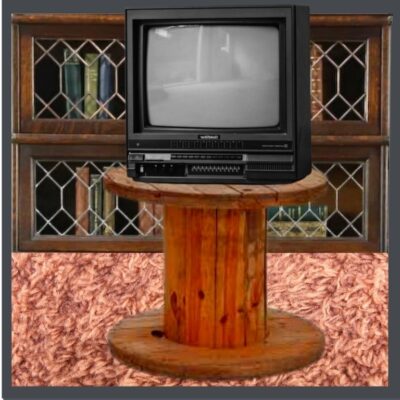
Then one day, I found my house-a 1910 Craftsman with long, matted, pink shag carpeting that reeked of eau de doggee. Looking up from the scary carpeting I gazed at sprayed popcorn ceilings & wondered at the lumpy stuff coating all the wood trim- wainscoting, plate rails, & box beams. (Yeah, someone had sprayed between the beams.) A heavily resin coated spool table sat squarely in front of one of the leaded glass bookshelves that flanked the fireplace. A television sat on the spool, clearly a place of honor as all the furniture pointed at it.
On the positive, I had walked in through the original door with its 1910 hardware & beveled lites. The living room was large with a nice, big picture window, looking out at a mature pine. The original gas lights were still there on the box beams, now fitted with electricity. x The leaded glass doors were still there beside the fireplace. All the interior doors were there with their lovely old hardware. All the original woodwork was there & I could imagine the wood floors under the gross carpet, waiting for me to come & rescue them.
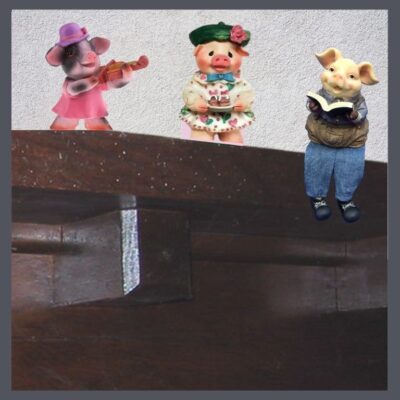 In the dining room, little Dollar Store pigs modeled tiny straw hats bedecked with itty-bitty flowers, atop the Douglas Fir plate rail because, as the homeowner explained, she loved, “Country.”
There was a vinyl pop-out window behind the sink in the kitchen cheerfully adorned with more molded resin tchotchkes depicting life on the farm. The bathroom had blue plaid wallpaper, with pink flowers trailing through it.
The closet of the master bedroom had been turned into a half bath & a truly disgusting vanity with a sink sat outside the closet door, in the bedroom. Yeah, I yanked it out & replaced it with a antique washstand & ceramic washset, but I didn’t use them!
But, it had many original features that were beautiful & I could see past the pigs & spool to know that this was my house.
We put in our bid. On the street, on the hood of my Realtor’s car. Trembling, while trying to look casual. My husband hadn’t even seen the house & here I was, leaping alone into this huge decision. I didn’t care. It was meant to be my house.
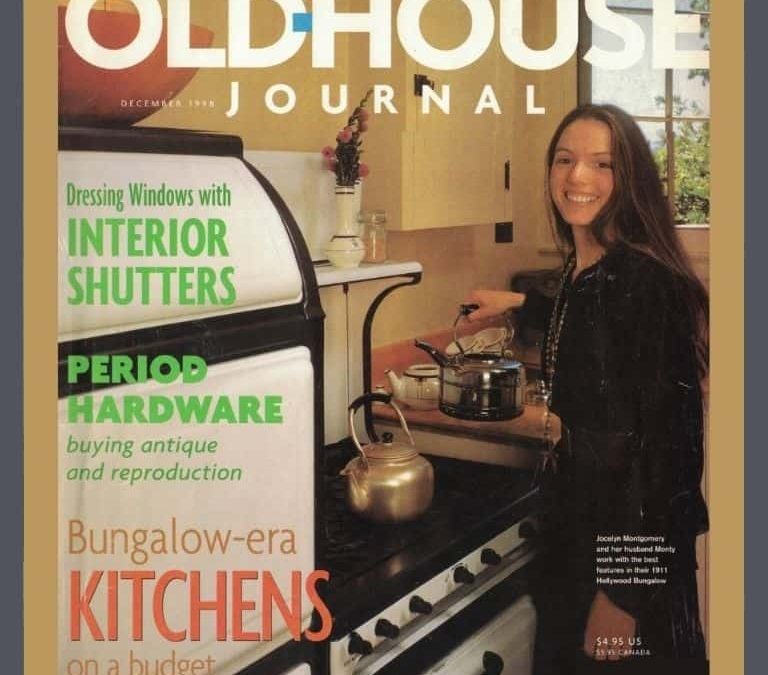
BUNGALOW KITCHENS ON THE CHEAP, BY BUNGALOW AUTHOR, JANE POWELL
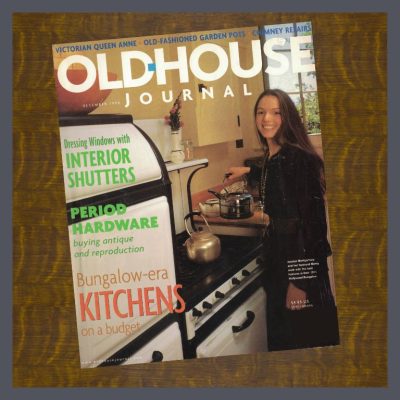 I was terrified. I had no idea what it would take to take this house back to 1910 & I was already 30% over budget. The kitchen was my greatest concern. I jokingly told my husband that I needed to find an article called, “Bungalow Kitchens on the Cheap.” I was on the edge of retracting the offer. I mean, I’d seen The Money Pit, & though I’d never owned an old house (or any house for that matter) I had lived in several & knew their tendencies.
That night we took a walk through downtown Pasadena & went into a bookshop. I poked around the magazine rack whilst Hubby browsed the Sci Fi. This magazine sat on the shelf with an article by Jane on creating old kitchens on a budget. Honest. This really happened.
The deal closed & we started rehabb’ing, pulling out the carpet, scraping the gooy stuff of the woodwork, & refinishing the floors. A month later, we moved in. I couldn’t live with the chemical smells so kept the house wide open during the day, but at night, closed it (It was late December, chilly even in Southern California) except for the windows above my bed. And I ran a fan. I slept in long underwaer & sweats & wore a knitted hat pulled down over my ears & almost to my eyes. Yeah, I was cold, but I didn’t care!
DOING SOMETHING ABOUT IT’
I had seen Realtor signs about the neighborhood & one day ran into said Realtor at Trader Joe’s. It was home tour time in nearby Pasadena & for some reason I asked when we’d be having our tour. She told me that the committee was meeting that night to start planning the first one. Honest. This was the answer to my question of what could I do about it?
I rolled up my sleeves & became a neighborhood activist. I learned how to speak for these buildings, telling their stories that I could hear clearly, but found that others needed to have the volume turned up.
PLEASED TO MEET YOU, BUNGALOW AUTHOR EXTRAORDINAIRE, JANE POWELL
 After the first tour was pulled off beautifully, I invited Jane to come and speak at a town meeting. She had written Bungalow Kitchens & Bungalow Bathrooms which I adored. I was stunned when she agreed to come to our little town.
Jane was so much like me that it was scary. We both had red hair & drove P.T. Cruisers. Purple was our mutually favorite color & we loved kitties. We both fervently believed that there was a special place in H-E-double-chopsticks for people who destroyed historic buildings. We were a coupla loud broads on a mission.
I have always loved old things- houses, furniture, clothing. When I was 6, I had an elderly neighbor whose very elderly mother was bed-ridden. She was left alone all day so every day after school, I scooted over & listened to her tales of how the world was when she was young. It changed me. Growing up I owned a vintage clothing store, collected antiques and always lived in old houses.
But my passion was unkindled, my path undetermined, until I bought that magazine & met Jane Powell.
Jane passed in 2012. Her heart & her humor left an indelible imprint on many of us. She transformed my life giving me beauty, purpose & community.
These many years later, I am still made happy & content by old houses. Now retired, I have the time to indulge myself & my chocolate is still bungalows.
Thank you, Jane Powell, bungalow author, expert preservationist, delightful individual & darn good friend.
TIP: READ ABOUT JANE’S BOOKS HERE.
STAY IN THE BUNGALOW KNOW!!!
Sign up for our newsletter & receive our FREE E-book, 7 VITAL Things to Do Before You Hire a Contractor.

by bungalow101 | Apr 20, 2022 | Random Musings
 This post is an overview of my old house restoration videos, arranged like my site, INSIDE, OUTSIDE & ALL AROUND. Plus, there’s a special section of THE MASTERS, without whose creativity, genius & pioneering spirit, our bungalows would not exist. There’s also a wonderful section on LIFE & TIMES which will tell you about the culture & technology of the period.
In each section, playlists are grouped by subject. Each video has been thoughtfully chosen to provide the most information, best images & most charming presenters for the given topic.
I find that fully understanding the bungalow requires having knowledge of its history, both as to both design & philosophy, some education on how the various parts work, some familiarity with the culture of the period & lastly, why preserving these charming houses is so important.
The videos will provide you with all of the above, directly from the foremost experts in preservation & art. I hope that you love them as much as I do!
LET THE OLD HOUSE RESTORATION VIDEOS BEGIN!

ARCHITECTURAL SALVAGE
The best resource for the old houses, salvage outlets are educational & entertaining.
AMERICAN ART POTTERY
Our country’s first contribution to the world art scene.
ARTS & CRAFTS LIGHTING
Lighting tips & a visit with some master artisans.
BATCHELDER
A genius artist of Craftsman art tiles.
INTERIOR DETAILS
What to expect inside a bungalow.
BUNGALOW KITCHENS
An extensive playlist with some great information & wonderful images of kitchens.
I LOVE LINOLEUM
What is linoleum, how is it made & why is it so dang cool?
KNOB & TUBE
What is it? Is it dangerous to have this type of wiring in your home?
MOLDING
Brent Hull, preservation master, explains how to choose appropriate moldings for your bungalow.
OLD GROWTH WOOD
How is this gift from this gift from the ancient forest different from that which is harvested today?
OLD TOASTERS
Beautifully designed & sometimes dangerous, see toasters developed after electricity was tamed.
SAFETY FIRST
When your house is a jobsite, there are some things that you need to know to keep yourself & your family safe.
WOOD FLOORING FOR YOUR BUNGALOW
Basic information on installation, patching, sanding & finishing.

BENJAMIN MOORE
Some great tips from my favorite paint manufacturers.
BUNGALOW DEFINING FEATURES
What the heck is a bungalow, anyway?
CHIMNEYS
A key character defining feature. Learn about how they are built & the problems they can have.
EXTERIOR SIDING
Learn how to deal with problems in 100 year old wood.
FOUNDATIONS
You can learn about them without getting dirty.
HISTORIC KIT HOUSES
Was your house built from a kit????
SCREEN DOORS
Gently letting the outdoors in.
WOOD WINDOWS
What’s all the fuss about?

BUNGALOW NEIGHBORHOODS
The high quality of life in an on old neighborhood.
HISTORIC HOUSE MUSEUMS IN THE U.S.
These museums allow you to step back into the daily life of times past. It’s the best way to learn about our culture.
HOME INSPECTIONS
Learn how to get the most from your inspection.
RESEARCHING THE HISTORY OF YOUR BUNGALOW
Videos to supplement the article on what to do & how to do it.
STAYING HEALTHY
The experts weigh-in on how you can help proof your body against the stresses & strains of historic restoration.
THE ARTS & CRAFTS MOVEMENT
Information & images that will show you how the Movement influenced the design of your bungalow.
WHY PRESERVE?
The experts explain the cultural, social & economic benefits of historic preservation. This is my favorite playlist.
TIP: If you want to know how you can benefit by becoming an educated bungalow owner or admirer, read my article HERE!

GREENE & GREENE
The brothers who brought the Arts & Crafts Movement to the West.
MACKINTOSH
Charles Rennie Mackintosh & the Glasgow style.
WILLIAM MORRIS
The father of the Arts & Crafts Movement.
CHARLES ROHLFS
A designer whose beautiful works were perplexing because they could not be categorized.
STICKLEY
The man, the designer, the entrepreneur.
FLW
A close look at Frank Lloyd Wright, the country’s most famous architect.

100 YEARS AGO
World events during the early 1900’s
FASHION & BEAUTY
How cultural changes impacted the world of fashion.
THE BEGINNING OF ADVERTISING
A consumer culture is born.
WOMEN’S SUFFRAGE
The determined fight to be granted the right to vote.
ART & CULTURE
The music, the cinema, the leisure time of the early 20th Century.
I hope that you have found these old house restoration videos to be as fascinating as I do. I perform a great deal of research & often surprising information pops up in these films that broaden my discoveries. And watching them is so enjoyable!
For more info on my favorite subject, the bungalow, go to my site map & enjoy the drive!
STAY IN THE BUNGALOW KNOW!!!
Sign up for our newsletter & receive our FREE E-book, 7 VITAL Things to Do Before You Hire a Contractor.
by bungalow101 | Jan 22, 2022 | Paint
IT’S ALL ABOUT THE CHEMISTRY- LEAD PAINT IN BUNGALOWS
 Yes, there is lead paint in bungalows. Let’s understand it & learn how to deal with it, better.
White lead, produced by corroding lead with vinegar, was used in historic paints to produce opacity thereby preventing the sun’s damaging rays from hitting the surface of the substrate. In addition, it was employed to decrease drying time & to increase durability. White lead also helped prevent the growth of mold & mildew.
In the early 1900’s, an effective substitute, titanium dioxide was developed & patented, but, the lead industry continued to mine & recommend lead, so we have lead on the walls of in our old houses & in our plumbing pipes. I have no children, so I am everybody’s mother. It hurts my heart to think of the children whose potential was & is still being diminished by their exposure to lead paint. (It’s my blog & I’ll cry if I want to.)
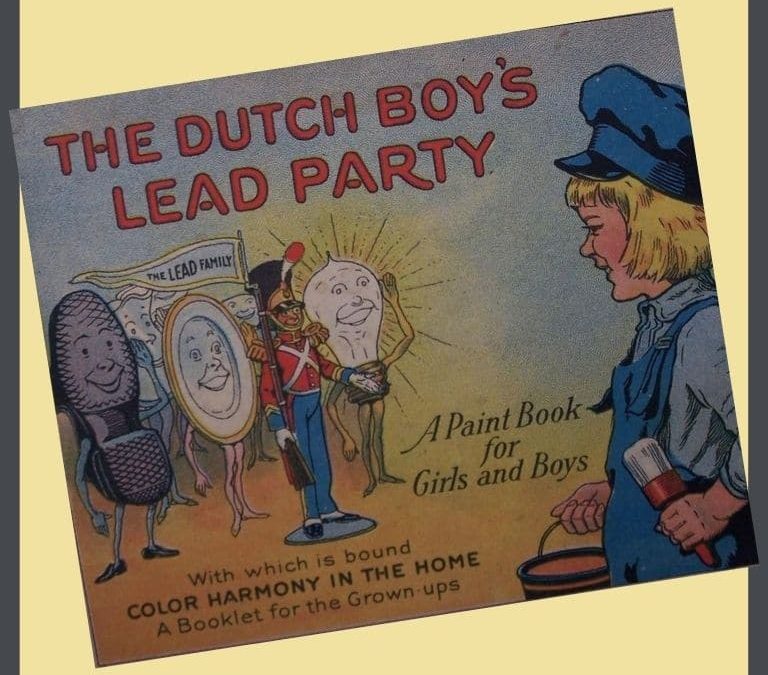
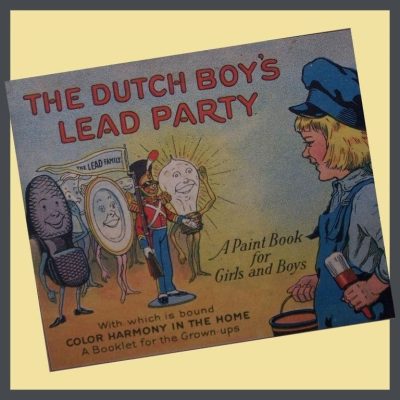
This charming little booklet, published in 1923, features the Dutch Boy on the cover, talking to the lead soldier. Inside there are 14 images of items that use lead such as a light bulb (lead glass), shoes & baseballs (lead in the rubber), & a bullet which we know is made of lead. A “Color Harmony in the Home” booklet is attached for adults. This coloring book for children was part of a campaign by the lead industry, portraying lead as a healthful element, necessary for a happy life.
The hideous truth is that lead’s toxicity was recognized & recorded as early as 2000 BC. Historians believe that the high exposure to lead, heavily used as a preservative, was a contributing force to the decline of the Roman Empire. In Germany, 1696, a decree was issued forbidding the use of lead-based additives in any wine product. The punishment for anyone who was discovered to have added it was death!
In 1763 Benjamin Franklin, wrote about the “dry gripes” (colic) and “dangles” (wrist drop) which affected painters, typesetters & tinkers, who went from house to house repairing household items made of metal. You can read his letter to a friend, both horrible & fascinating, about the ill effects of lead that he had both experienced & observed, here.
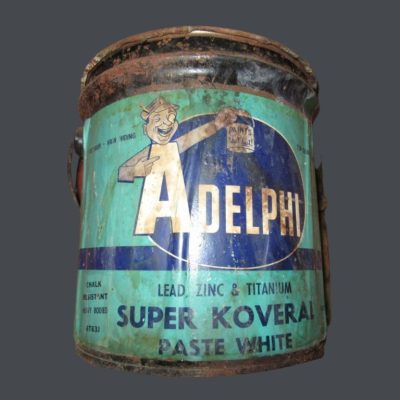 In “A Small Star in the East,” Charles Dickens, an astute observer of the damaging effects of the Industrial Revolution, wrote about the terrible results of lead poisoning on the poor women who worked in London’s white lead mills. “Her brain is coming out her ear & it hurts her dreadful…” 1868.
In the 18th, 19th & 20th centuries it was well known that to work in an industry where you handled lead was going to make you sick or even kill you. However, here in the United States, the lead industry fought fiercely to quiet, even intimidate, researchers & doctors who reported on or identified lead as a hazard. In 1867, the first prepared or “ready mixed” paints in the United States, were developed, spreading the lead danger to the people who worked in the paint plants, & on their dusty work clothes, to their families at home.
Lead was banned from house paint in Australia in 1914. That same year, childhood lead poisoning was first reported in America. However, lead wasn’t banned for use in paint in America until1978, a full generation later. And that’s why there’s lead paint in bungalows. Gack!
WHY AM I TELLING YOU ABOUT LEAD PAINT IN BUNGALOWS?
 Because the first people that I ever knew to renovate an old house had a baby. Mom was pregnant during the work & when she delivered, it was tragic. I am not going to describe the situation to you any more than this, but it affected me profoundly. The baby was tested for heavy metals & she was off the charts for lead.
Many of you will be hiring painters. Lead paint disturbance is highly regulated by the EPA, but it is also highly disregarded as a hazard, because some people don’t care about mothers & babies & mitigation can drive costs up. I urge you to be willing to pay the higher expense of hiring a painter who does care about mothers & babies, & is certified (by the EPA) to test for & handle lead. The EPA lead booklet, Renovate Right, which will provide guidance for you, can be found here.
Another EPA booklet, Fight Lead Poisoning with a Healthy Diet explains how you can help your children by providing them with good nutrition. It tells you to keep them well fed because children with empty tummies absorb more lead than children with full ones. It advises you to serve foods rich in iron, calcium & Vitamin C which can help protect children from lead poisoning. It provides lists of foods with these nutrients.
THE EPA also offers recommendations for lead test kits. There are techniques & tools that can be used in handling lead. If you live in a house built before 1978, you should assume that you have some lead paint in your house. You might want to perform lead testing in your bungalow.
If you use a pro to paint, I am suggesting strongly that whomever you hire is trained & certified by the EPA to perform lead testing. They will give you a copy of Renovate Right.
WHAT IS PAINT?
 Pigment, Binder & Vehicle
Paint is a dispersion, a mixture in which fine particles of one substance are scattered throughout another substance. It contains small solid particles, usually crystalline, (describing a substance in which the constituent atoms, molecules, or ions are arranged in a regular, repeating three-dimensional pattern) in a liquid medium. When it is applied to a surface, it dries to a solid, protective film, which enhances the beauty of the object to which it is applied.
Pigment
The pigment is the part that we usually care about the most- the color. However, it also has the job of making the paint opaque, blocking ultraviolet light, which causes deterioration to the substrate (an underlying layer or substance.) You have seen old buildings covered in flaking paint whose wood is clearly dried & deteriorating. It’s not protected.
Coloring pigments were also added. Originally, these colors were from natural sources but expanded in range & materials as chemists created more hues.
Binder
For oil-based paints, linseed oil, a colorless to yellowish oil obtained from the dried, ripened seeds of the flax plant (Linum usitatissimum), was frequently chosen because it is a drying oil. It causes the paint to darken over time, which is why Jane Powell always hollered about the use of white-white paint. It’s just not a historic possibility!
Vehicle
The fluid component was termed the vehicle, or medium, because it carried the pigment. Historically, vehicles included turpentine in oil paints. Linseed oil paint was often thinned with an organic solvent, such as turpentine for easier spreading & the enhancing of its drying speed.
Recently, people have become more generally aware of the dangers that these chemical pose. We use latex paints which, while they may not contain lead, release fumes containing a variety of chemicals, some of which may have short- & long-term adverse health effects as they dry & cure which can take some weeks. The fumes are produced by Volatile (easily evaporated at normal temperatures) Organic Compounds (organic compounds are generally any chemical compounds that contain carbon-hydrogen bonds.)
MORE THAN JUST LEAD IN BUNGALOW PAINTS
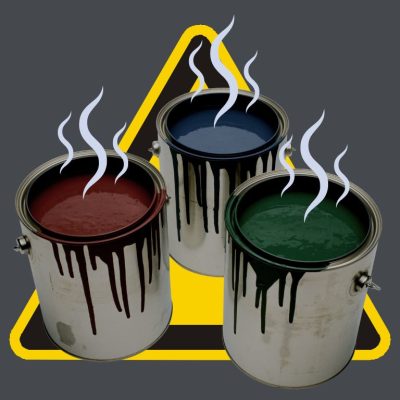 Modern paints are far more complex chemically than early paints. Additional ingredients have been added to the simple 3-part system of pigment, binder, & vehicle. Different paints have different chemical make-ups. The actual gases depend on the formula of the paint. Usually, the greater heavily tinted & glossy the paint, the more VOCs are released.
Be aware that even today, there are other chemicals in paint that are hazardous. Make sure that you follow all the safety instructions- PPE, ventilation, clean-up & disposal- that are suggested by the manufacturer. Here’s an article on how to read a Safety Data Sheet. Encourage your painter to do the same. Yes, he may grumble, but if he hears it enough, he just might listen. Here are some videos that will provide you with an orientation to the use of PPE as suggested in the Safety Data Sheet.
There are low & no-VOC options & more are being formulated all the time because of public demand. I’m going to start researching them, so stay tuned.
IF YOU HAVE MISSED ANY ARTICLES IN THE COLOR SERIES, IT”S NOT TOO LATE TO GO BACK!
 Part 1, THE COLOR LESSON
How to combine colors on your bungalow to most enhance its features.
Part 2, COLOR HARMONY
Combining colors to please the eye.
Part 3, THE ARTS & CRAFTS MESSAGE
The philosophy behind the beauty.
Part 4, OLD BUNGALOW COLORS
Color choices when our houses were constructed. .
Part 5, WHAT ABOUT PAINT COLORS FOR YOUR HOUSE?
How to use everything you know about color to pick your dream colors.
Part 6, PAINTING YOUR BUNGALOW EXTERIOR CHECKLIST
Making the big choices.
STAY IN THE BUNGALOW KNOW!!!
Sign up for our newsletter & receive our FREE E-book, 7 VITAL Things to Do Before You Hire a Contractor.